
NURSING HOME that minds its own business. Waterloo Care Center, 240 W. Shaulis Road, Waterloo, Iowa. (319) 234-4416.
—1980 Christopher Street classified ad
***
Cole bounced up and down on the mattress. It was more comfortable than their one at home. Cole made a mental note of that for future reference. You never know.
He looked at the empty, unmade bed against the far wall. Tyler’s roommate George had been wheeled out for something or other shortly after Cole arrived. He and George hadn’t spoken yet when the attendant, the ruder one, came for him.
Tyler’s bed had been stripped of everything, beginning with the urine-proof plastic covering. Two pillows were piled atop each other at one end, a tangle of wires and tubes at the other. Cole had never sat upright on the mattress before, though he had laid beside Tyler on it any number of times, Tyler beneath the covers and Cole on top. He usually sat on the metal chair that was between Tyler’s bed and the roommate’s. He would move it around to face Tyler when he visited, and put it back in place when he left.
The window’s curtains were drawn back, and someone had raised the venetian blinds behind them. The sunlight backlit the knickknacks Tyler and George had lined up on the wide sill, each in charge of curating their respective halves. Framed photographs, but also a snow globe with the Statue of Liberty in it, and action figures of the two Klingon Duras Sisters, Lursa and B’Etor. Cole knew those belonged to Tyler, not just because they were on Tyler’s side of the sill, but because Cole had given them to him.
Cole had a partial view of the parking lot and the uninteresting row of trees planted between it and the highway. He thought he could hear traffic racing by. He’d never been in this room when it was so quiet, minus both its occupants. Then: What sounded like metal pans clanged in the hallway, ending the silence.
“Mr. Wystan?” said the nurse, when she walked into the room. Cole could partially see her cart in the hallway. It had metal bedpans piled up on top and several large plastic buckets on the shelf below.
“Cole.”
The nurse’s face displayed concern. It was the well practiced, frozen look of someone who worked at an assisted-living facility, where residents die all the time.
“Cole, We’ve gathered Mr. Smith’s . . . “
“Tyler.”
“Yes. Tyler. We’ve gathered Tyler’s personal effects for you.”
Cole looked out the window again.
“You didn’t gather all of them.”
“Pardon me?” the nurse said, taking a tentative step closer, as if she needed to hear better.
Cole gestured dismissively with a flap of his hand. “He still has things on the window sill.”
The nurse said they must have missed them because the curtain is always closed. What’s the point of having a fucking window then, Cole thought to himself.
“No problem,” Cole said. “I’ll take them with me.”
Cole was listed as Tyler’s next of kin on all his forms. He was no such thing. Cole picked up framed photos of Tyler’s biological family and the one with him. It was a picture they’d had taken when Tyler was still capable of walking. They posed in front of the Liberty Bell in Philadelphia, on one of their last, frantic trips together. Cole had asked a stranger to take their picture. The whole while he was frightened the stranger would run off with his cellphone, and then there wouldn’t be any pictures of their trip at all.
Cole put the photographs next to him on the mattress. He stood up and moved little Lursa and B’Etor to George’s side of the window sill. Now George would be in charge of defending the United Federation of Planets from the Klingons’ evil schemes.
***
Cole sat outside on one of the cedar benches that flanked both sides of the main entrance. He had three new paper bags alongside him, each labeled SMITH, TYLER. One was much heavier than the others. That must be the one with Tyler’s shitkicker boots in it, the ones Tyler wore the day they came here. The bags were stapled closed and Cole hadn’t peeked inside. The stacked pile of framed photographs was secure in his lap.
Cole was in no hurry to go. He watched the slow human traffic pass by. One woman was in a wheelchair, pushed by an attendant, one of the nicer ones. Two of the residents were self-propelled, if barely, in their walkers. A young couple was helping another person painfully extract himself from the depths of the back seat of a car.
Everyone who would be spending the night here were ancient. Old beyond old. How old, Cole couldn’t quite guess. Oldness was a world he had spent no time in, his trips to this geriatric warehouse aside. Everyone’s so old here, was Tyler’s frequent complaint.
Tyler wasn’t old when he died.
Tyler was twenty-seven, and twenty-eight was still a ways off. Cole was twenty-seven, too. Their world, until three years ago, was one of other twenty-somethings. That world was now one-person fewer.
The first harbinger of their future came on a hike around a lake. Tyler had been depressed and cranky for a few weeks, and Cole had decided they needed to get out of their dorm. They’d driven an hour and a half out of town and parked Cole’s Honda near the trailhead, setting out with their daypacks.
It was on the way back, in the late afternoon, that Tyler’s knee gave out on him. He’d been complaining on and off since lunch about a sharp stab of pain that ran up and down his right leg, but Cole had paid little attention. The view of the lake and the hills behind it were beautiful. It had appeared as if by magic when they crossed the top of the rise. The lake was a silver color, and it might have been a perfect oval had it not been for a jagged shoreline at its top, what would have been unnatural symmetry spoiled by a defect. Cole stopped to study it. He didn’t hear anything except for the faint gasps of Tyler out of breath behind him. No birds, no traffic, no one talking. When he catches up to me, Cole had decided, I’ll take his hand in mine and tell him they’d made it to a perfect place. No rain, no wind, no people.
Cole remembered everything about that day. He had fantasized about descending to the lake and going skinny-dipping in it with Tyler. He’d wanted to see Tyler naked against the backdrop of nature, halfway into the lake water and with the hills in the distance. Tyler, he knew well from their love-making, had a boney hairless body save for a small but thick dark bush. Cole had thought that would be two beautiful things: the landscape and then Tyler, pasted together in a collage.
“It’s like my knee decided to go one way and the rest of me another,” Tyler whined as he sat on the ground and rubbed his leg. “Sorry ‘bout that. Let’s rest a moment.”
They rested. When the sun was low in the sky, they went back to the Honda and started the drive home to campus. Cole never got the chance to see Tyler standing naked in a lake. Things just didn’t work out that way. Tyler’s body lost its symmetry that day, and it would not come back.
***
The diagnosis, Tyler told him, was Huntington’s Disease. “The early stages.” He’d be clumsy, and start to get forgetful. Sometimes, he’d have trouble swallowing. No problem getting around yet, though.
Tyler never talked about an “intermediate” or “late” stage to his illness. He knew Cole would have read up about that on the internet, or in library books. Tyler also knew that Cole had done a lot of research for their weekend trips. Philadelphia was just the first. There had been New York and Chicago, too. The apartment they had shared since college looked like a travel agency crossed with a bus depot, brochures and small suitcases scattered all over.
Tyler liked their time at the Grand Canyon the best. Cole knew this because Tyler had pronounced it sublime, the one and only time Cole heard his boyfriend use that word. Tyler was stingy with words, and the slow, steady progression of his disease made him more so.
They drove to the Grand Canyon and back. Cole rented an SUV and outfitted the rear so they could sleep in it. They stopped overnight in Walmart parking lots and state parks, wherever there were power hookups and toilets. At the Grand Canyon, every place was filled up with other tourists, so Cole took the vehicle around the back of a restaurant late at night and parked illegally until the next morning. A garbage truck emptying the dumpsters woke them up. That night, for the last time, Tyler and Cole had had sex like normal people do. After that, it was always one healthy person and then one whose body resembled a broken doll.
“Don’t know if I got it from my mom or dad. The defective gene,” Tyler remarked on the long drive home from Nevada, all other topics of conversation exhausted. “Might’ve been both.”
“You were adopted. How could you know?”
“There are ways. Court records and stuff.”
“Are you thinking about that?”
“I think about a lot of things.”
Tyler’s doctor had warned Cole about this. At first he kept an eye on him, but it was hard to do so without treating Tyler like a criminal suspect. You treat an invalid one way and a suspect another. Eventually, he decided it would be Tyler who’d determine these things. Cole would leave him with that much dignity. He moved the pill vials from the bathroom medicine cabinet to the stand on Tyler’s side of the bed, next to the glass Cole always kept filled for him with expensive bottled water, as if that could be the cure.
***
In the end, there was no dignity. Others had to make the decisions. Tyler protested none of them – he’d graduated from the denial phase long ago. Cole’s mother had gone out the same way, according to his father. “She was a baby again, Cole. Diapers, spoon-fed and helpless. Couldn’t put the simplest sentence together anymore. God Almighty, give me a sudden heart attack when my time comes,” his father had said, and God did.
Tyler’s time came, too, but in long, drawn-out stages. “We should talk about assisted living, Cole,” the doctor had said to him. “Have you spoken to Tyler’s family?”
Cole lied, for the umpteenth time, that there wasn’t any family. Cole had power of attorney, and it was his name all over Tyler’s Medicaid forms.
“Some place nearby.” Cole had started sleeping on the living room sofa two months earlier.
“You and Tyler have choices, Cole. Visit a few, then talk to Tyler.”
The hospital gave Cole a list, and he would go through them alphabetically. He’d visit them without calling first. He wanted to see what these homes looked like without giving them advance warning. Cole studied the list while he sat on the living room sofa. He wrapped himself in the blanket he used at night. Cole could hear the television set in the bedroom, the volume turned low. He’d moved the set there once Tyler spent nearly all his time in bed. The list didn’t mention which accepted Medicaid patients.
Cole opened his laptop and used Google Maps to find each of the places on the list. First, he figured out how far away each was. There wasn’t any information on the list about how big they were, or what the cost would be. But they did, in parentheses, say a few words about “specialized care.” Cole scanned the list for “Parkinson’s Disease,” which Tyler didn’t have, but which he’d read Huntington’s would resemble toward the end.
There were five that mentioned Parkinson’s, and three of them were within a half-hour drive. Cole intended to visit Tyler every day, if only to let the staff know someone had an eye on how well they were taking care of him. He whittled his list down to four.
“Looking for a family member,” he’d told the woman at Glenwood Place’s reception desk three days later. “Was hoping to get a tour. Maybe speak with someone.” While he waited for the woman to assemble papers and attach them to a clipboard, he thought about the smell he was smelling, the same stink he would notice at the other places. Strong cleaning fluid odors mixed with something sickly sweet. Tyler will hate this, Cole thought, but after an hour or two here, he won’t be aware of it anymore.
Cole had to fill out three pages of questions before he’d get what he’d asked for. He left a lot of them blank, either because he didn’t know the answer or because he didn’t feel like putting lies down on paper.
A lady with a perfect helmet of frosted hair came out to greet him. “Hello, Mr. Wystan.”
“Cole. I’m Cole.”
The lady smiled at him. “Welcome to Glenwood, Cole. May I show you around?”
The lady, who never told Cole her name, had not read any of the forms he had filled out. She asked him all the same questions. He answered patiently, remembering why he was here. No, I’m not researching anything for a parent. I’m here for a friend. He has Huntington’s Disease.
“So young,” the lady said, with exaggerated sympathy. “Many places won’t take such a young person.”
“Why is that?” Cole asked.
Instead of answering his question, the lady kept smiling.
“Here’s one of the two day rooms,” she told him, sweeping her arm in an arc. They stood underneath the wide door jamb to a room with a fireplace, chairs and several sofas. There were two gray-haired women watching the television from one of the sofas, sitting as far apart as they could. Whoopi Goldberg’s face filled the screen. A man, just as old, sat at a table looking absorbed in his own thoughts. Cole made eye contact with him, but the man’s expression said nothing back to him.
“Most of our residents are women. They’ll be so happy if your brother comes to join us! Some residents will be in the physical therapy room now. Let’s take a look. We’ve just installed a hydrotherapy tank.” Cole nodded as if he knew what that was.
On their way down the long hallway, they stopped at a pair of open French doors. The large room was full of tables, each with four chairs, but empty of people.
“The dining room! There’s always a choice of two mains at lunch, and three at dinner.”
The physical therapy room had half a dozen people in it. One woman sat on a stationary bicycle but wasn’t pedaling. The others, also women, sat on padded benches in front of a rack with small barbells, talking animatedly with each other. The hydrotherapy tank was empty. He listened carefully to what the old women were talking about. It was about what color yarns they were bringing to the crocheting hour that afternoon.
“There’s usually a staff member here to help the residents. Let me go find her and she can explain the equipment to you. Stay right here!”
Cole took advantage of his guide’s departure to make his own. He scurried down the hallway. He would make his get-away without a word. But when he passed the day room, he saw the old man still sitting by himself at one of the tables. Neither his look nor his posture had changed. Cole entered, pulled out the chair opposite him, and sat down.
“Hi. I’m Cole. I’m here because my boyfriend is dying, and I can’t take care of him by myself anymore.”
The man’s lower lip quivered a bit, but no sound came out of him.
“Any advice for me? For him? Would he be happy here?”
Cole waited. When no advice was forthcoming, and the old man’s lower lip stopped quivering, Cole got up, moved the chair back into place, and resumed his hurried exit from Glendale.
***
At Meadow Lake, there were several people talking to the front receptionist. Their conversation, which sounded urgent, went on for a while. Cole sat patiently in one of the nearby lobby chairs. The place had the same musty, old-people’s odor as Glenwood, just not as strong. Perhaps that was because he was sitting near the glass doors, which admitted fresh air when anyone passed through them.
When the receptionist finally interrupted the people talking to her, it was to ask Cole what he was here for. “Seeing family?” Cole answered her. She waved him in with a gesture of her hand which said, here’s at least one chore I can be done with easily.
“Feel free to show yourself round. We’re a little short-handed today.”
Meadow Lake was laid out like a wheel with spokes. At their hub, where he now stood, there was an enclosed area with no roof above it. The weather was nice that day, and the enclosed atrium had people in it, sitting on benches or in wheelchairs. There were a number of green plants, some in the ground and others in large pots. The sun was bright, and poured through the glass walls to illuminate the indoor area, where more old people sat. Two were in wheelchairs, and they were chatting with each other. Cole could see one of the staff, dressed in a well-fitting white uniform, try to maneuver her way around the wheelchairs blocking her path.
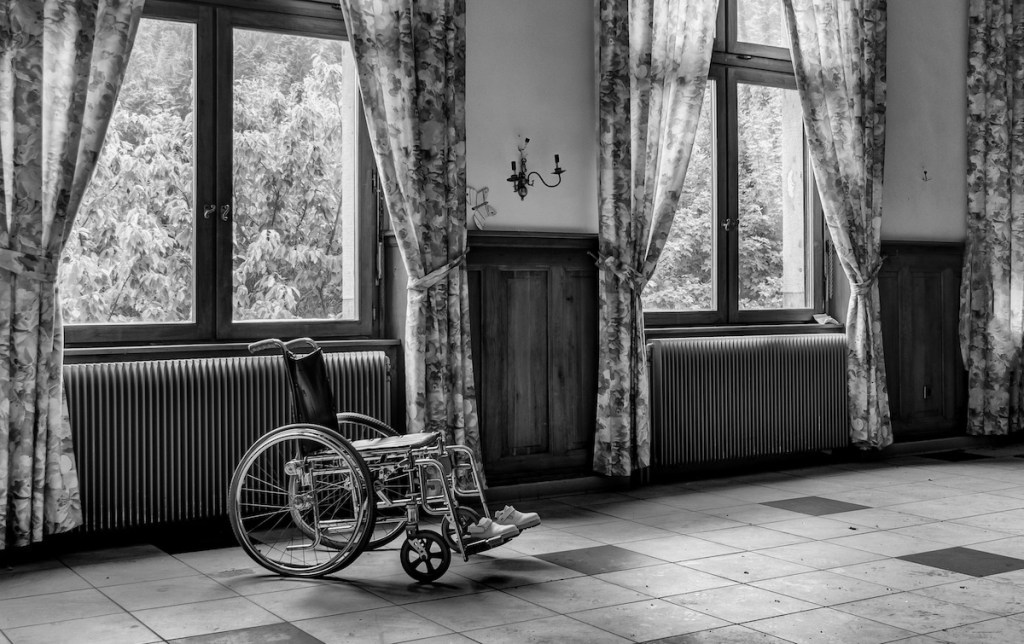
Wheelchairs are the icon of the frailest among us, Cole thought. It’s the picture they put on signs warning you not to park in this or that space. He and Tyler had a wheelchair in their apartment, a basic model, but they seldom used it. It embarrassed Tyler to be reminded of his handicap, and he made Cole keep it folded up in their living room, so he wouldn’t see it in their bedroom. This only made more work for Cole, who had to bring it into the bedroom every time Tyler needed it. But he didn’t mind.
There were any number of directions Cole could go explore. There weren’t any signs to tell him what he’d find. He set out down a hallway where a few doors were open. He’d be able to peek in. Cole didn’t relish invading anyone’s privacy, but like at a gay bathhouse, if the door was open, its inhabitant welcomed peeking strangers.
The hallway walls were cinder blocks painted a pale beige, and the floor was the same simple linoleum pattern everywhere. It reminded Cole of his junior high school. The doors had numbers on them, and small windows.
The first open door he looked into would be his last. It was some kind of examining room, like in a real hospital. It had all kinds of medical supplies, oxygen tanks with tubes and masks attached to them. In the middle of the room was an elevated table, and the old woman on it had her face turned away from the door. Wide canvas straps bound her to where she lay.
An attractive woman in a nurse’s uniform came up behind him. “Are you family?”
Cole didn’t lie when he replied he’d just gotten here, but he knew he was misleading the nurse. Something told him to. “What happened, exactly?”
“Well,” she said, “As I said over the phone, your grandmother’s roommate — Gerty, do you know her? — woke up this morning and found Sally on the floor. She must have fallen out of bed, we think. Even though the gate was up. I can’t imagine what happened.”
“Is she knocked out?”
“We gave her a sedative. She was very agitated at first.”
“Why is she tied up?”
“Well, so that she won’t fall again. Precaution, you know.”
“What does the doctor say?”
“Dr. Rosenberg doesn’t come in on Wednesdays.”
“Shouldn’t she go to the hospital?”
“Oh,” the nurse said sympathetically, but also as if talking to a child. “We don’t bother the hospital with every little tumble. Visits to the hospital upset the residents. She’ll be fine.”
“Why did you call me, then?” Cole asked, still pretending.
“Well,” the nurse said, even more sympathetically, “You never know, do you? Sally is getting up there in years! The poor dear.”
Cole asked where the men’s room was, but he didn’t use it. Instead, he walked back to his car. Outdoors he noticed raised furrows in the lawn, a sure sign of infestation with eastern moles.
***
The receptionist at the Waterloo Care Center asked Cole if he minded one of the residents giving him the tour. Cole did not.
“Hello, young man! I’m Hazel.” The resident appeared out of nowhere instantly. She was dressed in a housecoat, and wore fluffy slippers. Cole wondered if he’d gotten her out of bed. He expected her to ask him questions about who he was and for whom he was checking Waterloo out for. She did not.
This place, like the first two, had the same peculiar odor, but it wasn’t peculiar to Cole anymore. But his walking tour with Hazel did not include any atrium with beautiful green plants, or an exercise room with a hydrotherapy tub. The Waterloo Care Center was bare-bones, with as few amenities as any “assisted-living” place could have. There was no muzak in the hallways. There was no rack of snacks in the dining room for residents to enjoy between meals. A sheet of yellow paper taped to the television in the day room said OUT OF ORDER.
“We have two gentlemen sharing a room together.”
“Doesn’t everyone?” Cole asked. No place he’d been to had rooms for singles, and he didn’t want Tyler to be alone anyway.
“Well, these two men, Kenneth and Reggie, they’ve been friends forever. Almost look like a married couple! They were in the Navy together. Two colored gentlemen, originally from the South.”
Cole got an idea what Hazel was trying to tell him.
“They’re wonderful bridge players. I don’t know what we’d do without them! Does your friend play bridge? We’d love it if more men played!”
Cole shook his head. He couldn’t think of a single game Tyler played.
“Let me show you my room, if you’d like. My roommate, Helen, is new here, too. Just under a month now, I think.” Helen smiled broadly.
Hazel’s room was at the end of a corridor. It had windows on two sides. She must have a lot of seniority, Cole figured, to have worked up to this. Or maybe she paid extra.
But the room showed no other signs of luxury. It was bare of any personal belongings that Cole could see. It had the same two dressers he’d seen in other rooms. Regulation-issue, he assumed.
But Hazel’s room had another woman in it. She was sitting upright on the edge of her bed. Her blond hair was pulled back into a long ponytail, making her high cheekbones even higher. She had a long, wide mouth, like Spanish women have. Her eyes were large and clear. But what struck Cole more than anything else, was that she was Tyler’s and Cole’s age.
“Helen, this is Cole. I’m giving him the tour!” Helen’s large and clear eyes made no sign of registering his presence. She stared ahead into space.
“A nice young man comes by every other day to visit her,” Hazel whispered to Cole, and she winked at him, adding, “I always leave the room when he comes, to give them some privacy.”
Back in his car, Cole drew a line through Wellington Manor, the fourth and last place on his list. He’d made his decision. It would be Waterloo. Where Wellington won his battle, Cole joked to himself.
***
After Cole told Tyler his decision, and after they had cried sitting cross-legged across from each other on the bed, Cole went to spend the night as usual on the living room sofa. But a sleepless hour later, he crawled into bed next to Tyler, careful not to wake him but determined that his body should exactly mirror his boyfriend’s own.
It was in that position where Cole had his nightmare.
He was in a nursing home, but he didn’t recognize it as any of the three he had visited. It was barely lit, and mostly dark. He stood in a hallway and watched as young men and women, dressed in white, helped the residents out of their beds and make their way to the day room. Once there, the helpers shoved the residents hard from behind, making them fall onto the floor. The pile of bodies grew bigger and bigger. Some smothered others to death with the weight of their bodies. The ones on top of the pile were still alive, waiting to be smothered in turn. Some were weeping softly. Cole searched the pile for Tyler’s face, but didn’t find it.
***
It didn’t take long to move Tyler in. They had help, not at their apartment, where Cole had done all the lifting, but from the staff when they arrived at the Waterloo Care Center with Tyler’s things in the Honda’s back seat. Cole took charge of arranging Klingon sisters Lursa and B’Etor on the windowsill.
The assigned room was empty, save for two beds, two dressers and a chair. There was a wheelchair folded up against the wall. He wondered if Tyler would be embarrassed by it, or whether he was beyond that point.
Cole sat in the chair in Tyler’s room as they gave Tyler his official welcoming tour of the facility. He didn’t want to go along. Instead, he talked with Tyler’s roommate.
“I’m George,” he said.
“Cole. My friend Tyler is moving in with you today.”
George grunted and turned to face the wall. Cole panicked at the thought that Tyler was going to be stuck with a roommate who ignored him. But then George rolled back to face Cole.
“He’s young.”
“My age.”
“The last two guys in that bed, they were ancient. Older than me.”
“There’s a young woman here. I met her.”
George raised his head, as if he were about to say something, but he didn’t. He let his head drop back to the pillow.
***
Cole stayed to have dinner with Tyler his first night at Waterloo. Fish sticks, peas, and little cups of butterscotch pudding. They ate together on the bed while George went to the dining room. After an attendant took their trays away, Cole climbed onto the bed with Tyler and lay beside him. He meant to get out of the bed before George got back. But he fell asleep as soon as Tyler did.
When he woke up the next morning, it was to discover someone had put a blanket over him during the night. There were two breakfast trays balanced precariously on the chair. George was in his bed, and Cole realized he wasn’t asleep only when he saw the old man’s eyes staring at him. He surprised Cole by speaking.
“I was going to tell you yesterday when you mentioned that young woman. Everyone at the Waterloo minds his own business.”
***
“I’m the only disabled person here.”
“No, you’re not. Old age is a disability, too.”
“Then I’m the only young disabled person here.”
It was Sunday afternoon, the day of the week Cole had the most time to visit.
“You’re not the only young disabled person here. I told you about that girl. And anyway, you’re only as old as you feel.”
“You’re a laugh — oh, I mean a dull cliché — every minute.” Tyler grinned for a moment but then frowned like a circus clown. “You’re referring to Helen. She’s catatonic. Might as well be a piece of the furniture. You want me to tell you what it’s like here, Cole? They play fucking bingo. Twice a week, they play bingo. For prizes. You know what else they play here? Balloon badminton. Thankfully, I’m too crippled to be picked for anyone’s team. Ha ha.”
“Tyler, when I checked this place out, they told me they were hoping for someone who plays bridge.”
“Bet it was those two old Black queens.”
“Kenneth and whatever-his-name? But no. Someone else did.” Cole didn’t want to say it was Hazel, for fear of her young roommate coming up in conversation again.
They were sitting on the building’s front lawn, Cole on a white plastic chair and Tyler in his wheelchair. It was the first warm day in a long time. The staff had put out the white plastic chairs just that morning.
“I thought you might like it here.”
Tyler shrugged. “The food’s okay, I guess. They give me stuff I won’t choke on.”
Conor reached for Tyler’s hand, intending to squeeze it. But Tyler swatted it away.
“We’re outside. Cars on the road can see us.”
“We can go back in, then.”
“God no.”
If Cole was tempted to say sorry, he also knew he’d never stop it if he started. He could guess what Tyler was thinking. Load me into our car and take me somewhere. Not our apartment, they’re sure to look for me there first. I see the Honda in the parking lot, just over there. Now’s our chance to escape.
But that was not what Tyler was thinking.
“What will happen when we run out of money, Cole?”
Cole told Tyler not to worry. Cole thought, shit, Tyler will react to that with an “Easy for you to say.” But what Tyler was really thinking, because he knew the money would last longer than he would, and because his question had been a test, was this: Are we going to talk about what comes next?
***
Cole was waiting in the day room for an attendant to bring Tyler out in his wheelchair when two elderly Black men approached him. It took them a while to reach him, because the shorter one was using a walker.
“You’re Tyler’s friend, aren’t you?” the one without a walker asked.
“Yes, I am.”
“He’s mentioned you. We’d love to hear more about you. But Tyler’s not much of a talker.”
Cole wanted to say: You didn’t know him before. They sat across from him without asking.
“Has he told you about the fight?”
No, he hadn’t.
“Well, you should probably hear about it from him, but he and Helen got into a terrible row. Do you know Helen? The other young person here?”
We’d been introduced.
“Reginald and I weren’t there when it started. We hadn’t come down for dinner yet. But when we did, well, it was already quite the scene.”
Reginald took over at this point. Cole could tell they had told this story before.
“They were shouting at each other. I mean, truly shouting. They were holding their silverware as if they were going to stab each other! Everyone stopped eating and stared at them.”
“What were they fighting about?”
“Well,” Reginald said, looking at Kenneth, “We thought you might know. I mean, those two never talk. That’s why we make them sit — why they always end up sitting, I mean — with each other.”
“We heard from one of the staff,” Kenneth added, “that it was something about being the unhappiest people here. You know, both so young and all.”
“Did anyone try to stop the fight?”
“Oh, no, no one would do that. You see, at Waterloo we pride ourselves about minding our own business.”
***
Cole made Tyler comfortable in the front seat of the car, and they went for a drive along the river. Tyler didn’t seem as depressed as before.
“I heard you got in a fight with the young woman,” Cole said as he crossed the river via an old wooden bridge.
“You heard right.” Tyler paused. “After all this time, she finally asked me a question, and it had to be about us.”
“Us? As in you and me?”
“She wanted to know how the two of us ever expected to enter the kingdom of heaven.”
“Shit. What did you say back?”
“Not sure I remember. Something on the order of shut up, you cunt, and mind your own fucking business.”
Tyler was lying. What he actually said to her was this: You are the only other young person here, and you have betrayed me. Tyler had more than once wanted to say much the same thing to Cole.
***
Cole got up from the cedar bench and put the three paper bags containing his boyfriend’s personal effects on the Honda’s front passenger seat. He’d gotten the call about Tyler’s death the day before. The message was left on his voicemail, and Cole hadn’t played it back until this morning.
Cole walked back to the building and into Tyler’s room. George was in his bed. There was now a tall green oxygen tank next to him.
“You were here.”
“Yes, when he died. I was. I’m sorry.”
Cole did not sit in the chair, nor did he move any closer to George.
“I woke up in the middle of night, don’t know what time. He was gasping for breath, like a fish out of water, but making a helluva lot more noise. Screeching. It was like he was trying to say something, but I couldn’t make it out. You know, he was having more and more trouble talkin’ anyway. Then there was crying, and more screeching. Terrible screeching. Like an animal.”
“Didn’t anyone come? Didn’t you call for help? Don’t you have, like, an emergency call button or something?”
“There’s just one person here at night. At the front desk. Smokes marijuana outside, just below our window. Stinks to high hell if I have the window open. And he never comes when we call him. Not sure if he even speaks English. No one bothers asking him for anything.”
“You can get out of bed by yourself. I’ve seen you do it, for Chrissake, when you have to take a fucking piss. Did you try to help him, old man?”
“We mind our own business here, Cole. That’s what we’re famous for, haven’t you heard that? Sure you have. That’s why we’re here and not somewhere else. That’s how you and your friend got away with what you got away with.”
***
On the drive home, Cole talked with the three paper bags next to him as if they were a real person. As if they were Tyler. They didn’t keep up their half of the conversation.
I’m not sorry I put you in an institution, Tyler. I couldn’t feed you properly, much less change your diapers, or lift you out of the bathtub despite all the weight you’d lost. Maybe I could have tried harder. They told us you had years, but you didn’t.
I’m sorry it was here, though. Waterloo. No, second thought, any place would have been just as bad, no matter how many I’d visited. How does anyone our age prepare for a goddamn old-people’s home?
I thought they’d let us be ourselves, behind closed doors at least, and that I would be enough to fix your loneliness. They did, but I wasn’t. Now I wish they hadn’t minded their own business. I wish they had helped you. I wish someone had been enough into your fucking business to have held you when you choked to death. There wouldn’t have been cars driving by to spot a stoned desk attendant holding your hand. God screw them, if they had. All you had with you at the end were the evil Duras Sisters on the window sill, and their little Klingon hands at the end of their little Klingon arms could no way, no how, reach yours.
John Whittier Treat has won the Christopher Hewitt Prize for Fiction and been nominated for a Pushcart Prize. His 2015 novel The Rise and Fall of the Yellow House, was a finalist for the Lambda Prize for Best Gay Fiction. A novella, Maid Service, was published in 2020 and his second novel, First Consonants, came out in 2022. Treat’s new novel is The Seventh City of Refuge, a contemplation of modern risk set among survivalists in rural eastern Washington State. His opinion pieces have appeared in the New York Times, the Huffington Post and Out magazine. His next project will be a collection of short stories exploring contemporary American masculinity. johnwhittiertreat.com
 ELEVENTH HOUR LITERARY