
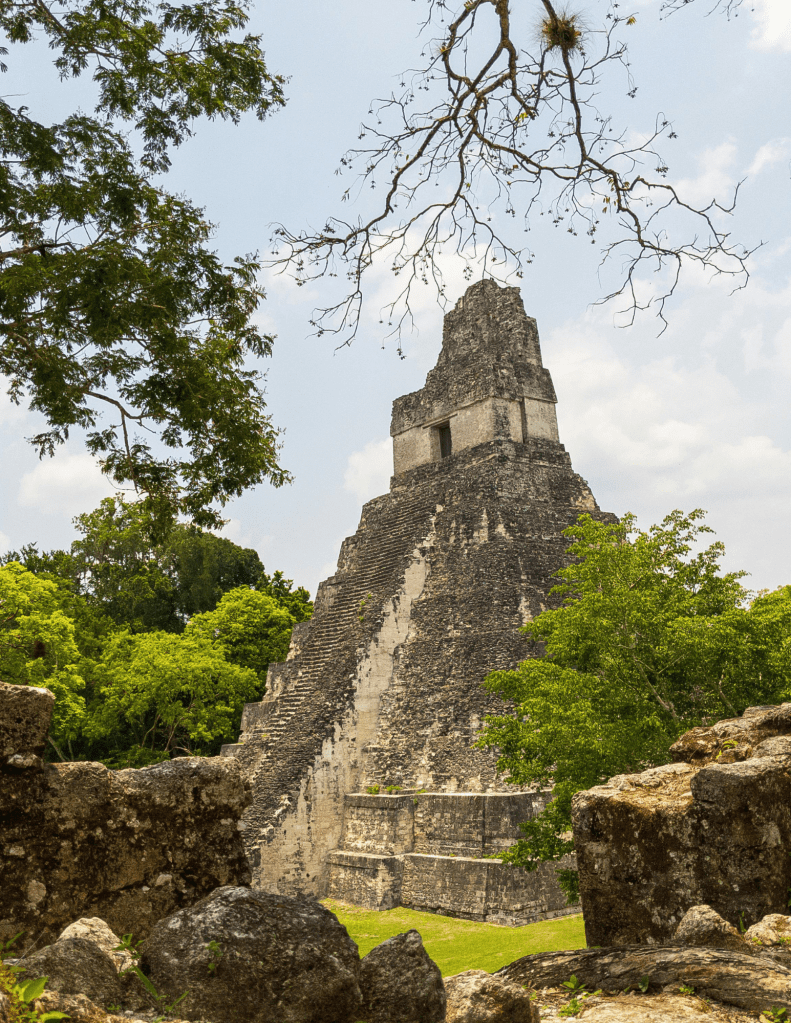
I didn’t think the bone was real when I first saw it. All the human remains recovered from the Laguna Embrujada site had been found in or near the central pyramid, not out here in the peripheral zones. But there it was, a human femur propped against the half-collapsed rock wall I’d been clearing. So obvious that Bradley should have seen it when he did his walk-through, before unleashing interns to clean the moss-fuzzed rocks.
I paused my work, crouched on my haunches. Studied the bone. The shaft was stained, the patterns similar to bones I’d studied in my senior-year Aztec culture seminar. Those had been carried, wielded as signs of authority. Except the Laguna Embrujada site was Maya and there was no evidence they’d had a similar practice. Which could point to it being a hoax. But why? I was about a month into my internship and there’d been no kind of newbie hazing, no practical jokes. Maybe they’d just been letting us settle in, but I got the impression it was a serious place. A fake bone was out of character.
I slapped a mosquito tickling my neck while I expanded my focus back out to the jungle. It was early still, the sun’s heat just starting to filter through the jungle canopy, thickening the air into the steamy soup that would have my clothes sweat-drenched and clinging by midday. The temperature most afternoons exceeded 35 degrees Celsius, which to my American mind sounded cold but I had been assured — in multiple languages, as if I couldn’t feel it for myself — was very hot. I palmed the walkie at my belt. I was supposed to call Bradley if I stumbled across anything worth cataloging. Human remains definitely fell in the too cool for interns category. Bradley had drilled into our heads that, if we did find something, we shouldn’t disturb it; he likened dig sites to ancient crime scenes, full of evidence one careless move could destroy. But I also didn’t plan to call him until I’d verified that it was a real bone and not a dolled-up Halloween decoration left here to make an intern look like an idiot.
Something crunched the leaf litter to my right and I looked around, thought I saw a flash of a wide-brimmed hat through the green. Probably just Connor cleaning the rocks of the next structure over. Nobody who’d notice or care if I engaged in some light rule breaking. I leaned forward, dead leaves crinkling, sticks and stones pressing into my palm as I put my weight on it and reached out my right hand to grab the bone.
There was a crack, a crash. I jerked my head up and registered the toppling tree but didn’t have time to find my feet before it hit.
***
I woke up in the medical trailer a few hours later, in pretty good shape considering a tree just fell on me. A concussion was the worst of it, and even that wasn’t bad enough to warrant the hour-long drive to the nearest hospital. Bradley came to check on me as soon as the field shift ended. He’d recruited most of the interns — myself included — and treated us like his personal charge. His default mode was a paternal flavor of overbearing that would’ve felt creepier if I hadn’t seen him treat male interns the same way. He seemed mortified that Connor had found me and not him, rambled an explanation for why he hadn’t been close enough to hear the tree fall. I nodded along in a daze. My lips felt numb, the ringing in my ears crescendoing with every heartbeat. My vision was still blurry, Bradley wreathed in a glowing halo like he was some kind of archaeological angel. He looked the part a bit, I guess, with his shoulder-brushing hair flowing from his wide-brimmed hat, his perpetual dark stubble. Bradley made wide eyes, shook his head in grave disbelief. “That wall you were working on — well, it’s just rubble now. Good thing you’re quick on your feet.”
“The bone saved my life,” I said, not really thinking, distracted by the constant ringing, the way my head felt both heavy and floaty.
“Bone?” Bradley asked.
“A femur. You must’ve found it.”
A line knitted between Bradley’s eyebrows. “We’ll have someone check.”
But that someone wouldn’t be me. I’d be sticking around camp until my concussion cleared up. Bradley left, telling me to get some sleep, and I tried to listen. Except every time I dozed off I had the same vivid dream of Maya priests laying sacrifice victims across an altar. In one iteration the lead priest’s headdress morphed into a wide-brimmed hat as he opened each captive’s throat, the dream so vivid I could see the jaguar head on his blade’s hilt, the glint of the rubies in its eyes.
***
By morning, my headache had dulled and I could walk in a mostly straight line. The nurse sent me to keep resting in the A-framed cabin I shared with the other five interns. It was mid-morning; the others had already been at work for hours, their beds neatly made. Someone had put my pack on my bunk. When I picked it up, it felt heavier than it should have been. I sat on the bed and pulled the bag into my lap. Inside, in front of my log book and my leather-bound wrap of tools, slanting through the negative space beside my half-full water bottle, was the bone.
A chill ran from my scalp to my fingertips as I pulled it out. It smelled like the jungle, a miasma of moist earth and decomposing leaves. All I could think, at first, was: I’m going to be in so much trouble. To take a bone from a site — Bradley would be pissed, maybe even pissed enough to fire me, and I doubted my excuse of I don’t remember taking it would be much help. This was the first dig I’d actually gotten paid to work on. And sure, the air here felt like a wet hand pushing you into the dirt, and every surface crawled with things that bit and stung and itched, and we were an hour-long colectivo ride from anything resembling modern civilization. But, for the first time, I would leave with more than I’d arrived with: not just room and board included but ten bucks an hour when I was actively on the clock plus a $3,000 bonus at the end of the season. If I got fired now, the pay I’d earned so far would barely be enough to get me home. And fired for stealing an artifact — I’d never get hired on a dig again.
All of which was secondary to the feeling I got, holding the bone. How it fit my palm like it was meant to be there. I crouched to open the under-bed lockbox. I’d cracked a joke when I first got here about what kind of valuables they thought archaeology interns would even own — all that I’d had in mine so far was my passport — but now I was glad for it. There was just enough space inside to slant the bone in at a diagonal and slam the lock in place to keep it shut.
***
At dinner, I grabbed a plate of bland rice and greasy meat from the buffet line and took it to my usual table with the other interns. Meals were theoretically communal — everyone ate the same food, under the same broad canvas tent — but there was a hierarchy just like out at the sites. The senior archaeologists took the tables closest to the food; the interns were tucked into the far corner, just enough under the tent that we only got a little damp when it rained. The sky was threatening an evening storm but we were dry for the moment, at least. I was the last to get there. Connor saw me coming first and called out, “Look who’s back among the living!”
“How are you feeling?” asked Jo, sitting to his right. She was my closest thing to a friend on the dig team, a fellow Midwesterner; we’d bonded early on by swapping tips for protecting our pasty skin from the sun.
“Still a bit wobbly,” I admitted. I slid into the empty end seat across from Jo and next to our fourth roommate, Eddy, who flashed me a full-mouthed smile and a nod of welcome.
Connor laughed. “No surprise. Honest to god, when I saw that tree, I thought you’d be dead. It took out the wall like it weren’t nothing.”
“What made it fall, anyway? Is that, like, something we should start worrying about now?” asked Eddy, knuckling his glasses back into place like he did when he was nervous.
Connor shrugged. “That’s what’s crazy. The roots were still anchored in and everything — something sliced the trunk, is what it looked like.”
“Maybe the priests were trying to collect their seventh victim,” Jo joked.
“Their what, now?” Connor said.
“You don’t know the legend?” Eddy asked.
“I have a feeling I’m about to,” Connor muttered, seeing how we’d all tensed forward eagerly. Jo, Eddy, and I tag-teamed the pertinent details: about the eccentric billionaire who financed the dig, how everybody thought he was crazy right up until he unearthed a step pyramid from a hill crest. Supposedly, he’d learned of the site from a codex containing the record of Manoa’s last priests, although nobody had ever seen the codex in question except for him. Legends said the codex told of the Spanish arrival, how the priests had buried the vault containing their civilization’s wealth and cursed it for good measure. The treasures of the Maya wouldn’t be found, the legend said, until seven explorers died, to match the seven victims sacrificed to seal it.
“And not just any explorers,” Jo wrapped up. “They have to be of European descent, and they have to die working on the site.”
“Guess everyone at this table’s fucked,” Connor deadpanned.
“Well, six people have died already, so technically just one of us,” Jo answered.
Eddy explained, “The first three were all at once. A scaffold collapsed during the main pyramid excavation — what was that, five years ago?”
“Around then,” Jo confirmed. “Then a couple of months after that a researcher had a heart attack. The next one was from a snakebite, like, a year later and the sixth was…” She sent her eyes skyward, searching her brain.
“Complications from giardia. That one happened last year,” Bradley’s voice chimed in. I turned to see him standing behind me. A bit too close; I had to tilt my head the whole way back to see more than the bottom of his food tray.
“You can die from that?” Connor said, eying his bottle of water with a fresh look of horror.
Jo said, “If there’s a Maya curse involved, you can, apparently.”
Bradley laughed. “I’m guessing we’re introducing Connor to the legend of Manoa?”
“In light of the fact that I almost fulfilled the curse,” I said, meaning it as a joke, but the flat line of Bradley’s mouth told me I’d missed my humor mark.
The conversation hitched for an awkward second then Bradley cleared his throat and said, “Speaking of — we checked the site again but we didn’t find any bones. Can you describe where you saw it?”
I flinched, covering by reaching for my water. I’d forgotten that I told him about the bone. I made a show of thinking hard then shook my head. “It’s all so jumbled. Maybe I didn’t see what I thought I did.”
“I suppose that’s fair.” Bradley’s stubbled cheeks creased in a smile but his eyes kept studying.
***
The tree’s topple proved a lucky accident. Its impact had opened a whole new area of exploration. It turned out the stone walls I’d been cleaning were just the top level of a structure—one that went quite deep, apparently, and contained a variety of artifacts, though my fellow interns didn’t know much about them; they’d been shifted elsewhere once the senior archaeologists realized the zone was worth their time. For my part, I was stuck on chore duty until the doctor cleared me to leave camp again. I spent my days mopping and scrubbing pots and doing other mindless things that left my brain free to spiral. I tried not to think about the bone but it haunted me. At night I dreamed of violence. I watched victims dragged to the altar, fighting their captors until the blade severed their necks; in one they played pok-a-tok — and won, but ended up on the altar anyway, kneeling for a priest who wore Bradley’s face.
The fifth day after the tree fell, I was making the laundry delivery rounds when a screech drew my eyes up, looking for a bird of prey. Instead, I saw the main trailer’s top-mounted antenna toppling toward me. I flung myself aside a second before it lanced into the ground. I laid there a second after, frozen, staring, then stood shakily, patting the dust from my cargo pants. I was sure I’d seen something moving on the trailer’s roof — a flash of khaki, a figure in profile — but it had all happened so fast; if anyone had been there they were gone by the time I looked. Then the trailer door opened and the archaeologists burst out, roused by the noise and their sudden loss of internet access.
“Talk about some bad luck,” Jo said when I told her what had happened, later that night in our tent.
“You think that’s all it is?” I asked.
Jo laughed. “What, you believe in the curse now?”
The senior archaeologists hadn’t seemed surprised that the antenna toppled. It had never been properly secure, they said; they’d complained about it before, knew something like this was bound to happen. But I couldn’t help wondering why Bradley had shown up later than the rest, with his khakis wrinkled and dirt-smudged, fanning his face with his wide-brimmed hat.
Jo went off to shower. It had become something of a ritual to check on the bone anytime I was alone in the tent. Once the screen door smacked shut behind her I knelt in front of my lockbox. But the bone wasn’t there. I searched around my bed, pawed through my duffle bag, finally yanked open my pack. It was sweet relief to see the bone. Positioned the same way as before. It seemed to like being there. I left it, closed the pack, and shoved it under my bed, out of sight.
That night, I dreamed I was one of the sacrifice victims, Bradley smiling as he ran the jaguar-hilted knife across my throat. I woke drenched in cold sweat, my head pounding with the certainty that luck had nothing to do with my recent mishaps. Whether it was a Maya ghost or my boss, something wanted me dead.
***
I decided, the next day, to take the bone back where I’d found it. It might not stay put, I realized, but I had to try; curse or no curse, my odds of nearly being killed had gone up dramatically since I touched it, and the timing felt too perfect to call coincidence.
Not that getting the bone back to the site would be easy. The secluded spot where I found it was now a hotbed of activity. Luckily, even the primary dig areas were abandoned after dark. Largely because traveling to them at night was idiotic. This area was remote enough that jaguars still roamed the jungle, along with a host of other equally deadly creatures, not to mention the ever-present risk of wandering off-trail and stumbling into a cenote. But I had to try. I might not avoid the next thing that fell out of the sky at me.
That night, I ate dinner quickly then feigned a headache and said I was going to lay down. At the tent, I verified the bone was still in my pack then grabbed it and my flashlight, hurrying toward the jungle. I slowed once I’d broken through the treeline. The paths our team had cut through the dense greenery were under constant threat of being re-absorbed; I had to periodically consult my map when the path seemed to vanish.
I was just starting to wonder if I’d made a wrong turn when I saw the glow ahead. A floodlight, I realized, which wasn’t unusual in and of itself — they were set up around all the major areas of the site — but shouldn’t have been on, this time of night. I clicked off my flashlight and waited, barely breathing. The floodlight’s too-white glow made a drama of every shifting leaf, branches stretching and reaching with every gust of wind, but I didn’t see any people; the only sound was the nighttime insect chorus. Maybe the day’s crew had just forgotten to turn the light off. Or the bone had turned it on to guide me. It could move, apparently, so who knew what else it could do?
I crept forward, hunched low, ready to bolt at the first sign of other people. The site was unrecognizable from the last time I’d been here. Before, the walls had stood on fairly level ground. Now there was a pit where the walls had been, too deep to have been dug by the team. Deep enough they’d mounted a ladder on the side closest to me; I could see its posts jutting up from the otherwise smoothed-over ground. A lump stopped my throat. I couldn’t help wondering how close the ground had been to collapsing before the tree fell on it. Whether I’d almost died in more ways than I’d realized. But no matter now, I told myself firmly. If anything, this worked in my favor. I’d just toss the bone into the pit and everyone would assume it had surfaced in the collapse. I crouched in the undergrowth, maybe ten feet from the pit’s edge, and slid my pack from my shoulder, unsnapping the flap. I felt blindly inside for the bone, wrapped my fingers around the bone shaft, and pulled — but it wouldn’t budge. I glanced down, holding the bag open with my left hand while my right twisted and tugged, freeing the knobs from where they’d been hooked by the spiral binding of my notebook.
“What are you doing here?”
My eyes shot up. It was Bradley, or his top third, at least, coming up the ladder out of the pit. His white linen shirt was darkened by sweat under the pits, his cheeks dirt-smudged over his stubble. I opened my mouth to answer but I was trapped in a rabbit kind of panic. Bradley’s eyes flitted from my face to my hand in the pack.
“It doesn’t matter,” Bradley said, waving away his own question then pulling himself up the rest of the way. “I’m glad you’re here, actually. I could use your help. I need to move some tools down for the dig team but the winch needs two people to operate.” Which didn’t make sense, I thought. Why he’d be doing this at night. Why he hadn’t brought someone with him in the first place. I started to stand but my head spun, eyes dancing with spots, and I sat down hard on the leaf-strewn dirt, fingers still wrapped tight around the bone in my bag. By the time I looked back, Bradley was standing at the pit’s edge, arms folded, annoyed impatience flattening his mouth — until he saw me looking; then his lips curved up in a warm smile.
“Seems like you’ve still got some concussion symptoms,” Bradley said. He shook his head, tone shifting toward fatherly. “You really shouldn’t be out here. Come on, give me a hand with this, then we’ll get you back to camp.”
Bradley unfolded his arms, right hand slipping into the pocket of his khakis. A long, hard-edged shape pressed briefly against the fabric. An image flashed through my mind of the jaguar-hilted knife I kept seeing in my dreams. And it was that shape, maybe, or the fact that Bradley wasn’t reprimanding me — didn’t even seem all that curious why I was out here, or what was in my pack — but I was suddenly very sure that he didn’t intend for me to leave the dig site alive.
I shifted to my knees while Bradley crossed the space between us. He held out his hand, like he meant to help me up. An offer I couldn’t accept, even if I wanted to; my fingers wouldn’t let go of the bone. Bradley frowned down at me, impatient, then glanced back toward the pit — and the bone struck. It flew from my bag in an upwards arc, pulling me to my feet with enough force that I stumbled forward. Bradley’s mouth opened in an O of surprise as the bone’s knobby end struck his temple with a crack. He shouted, hand flying to his face as he stumbled back two steps, three. His fourth found nothing but air, his arms windmilling as he fell backwards and disappeared.
My arm fell to my side like a puppet with its strings cut, my legs giving out. I crawled forward on my knees, peering over the edge of the pit. The cavern was even deeper than I thought, a solid thirty feet, Bradley’s twisted body looking small on its floor. He’d hit the wall a couple of times on his way down. A slow trickle of rocks and dirt were sliding over him but not fast enough to cover his staring eyes, his expression frozen in surprise. At his side, like it had fallen out of his pocket, was a slender blade. Even from this distance I could see a flash of red, the ruby eyes of the jaguar on its hilt reflecting the floodlight.
My fingers finally unclenched from around the bone, but I couldn’t leave it now. It was evidence. Covered in my fingerprints. Stained with Bradley’s blood. I shoved it back in my bag then sprinted down the path, only slowing to flick on my flashlight when the jungle’s shadows absorbed the floodlights.
***
One of the senior archaeologists announced Bradley’s accident at breakfast the next morning. Rumors said they’d also found a wheeled cart loaded with artifacts, ones Bradley had apparently been halfway through stealing. Which explained what he’d been doing out there, if it was true, but nobody called authorities to investigate further. That would’ve stopped work on the dig, or at least slowed it, and nobody wanted that once they saw what Bradley’s tumble had uncovered. A carved stone door had been buried behind the packed dirt. It led to a room paved in gold, filled with statues and jewelry and gems, the accumulated wealth of a dead empire. Perhaps the greatest treasure was a codex, remarkably preserved, the pages still intact and legible. I didn’t know enough of the Mayan language to read the text but I saw some of the images. One spread showed an action sequence, like panels in a comic. In the first, a headdressed man prepared a victim for sacrifice, while beneath his feet seven past victims watched. In the next panel, a victim’s skeleton rose and attacked the headdressed man, wielding its own thighbone as a scepter. The skeleton was the only one standing in the last image. It still held the bone aloft, and wore the sacrifice victim’s skin, like a cape.
Despite these images, or maybe because of them, I put the bone back in my lockbox. It would tell me when it was ready to go back, I figured; if it hadn’t disappeared by the time my internship ended, I’d sign on for another season. The bone had chosen me. Protected me. It only felt right to return the favor.
Jess Simms is a freelance writer from Pittsburgh, Pennsylvania, where they’re a co-founder of Scribble House and the managing editor of After Happy Hour Review. They are the author of the flash fiction chapbook Cryptid Bits (Last-Picked Books, 2024) and have published stories and essays in Mythaxis, Orca, SLAB, Atlas Obscura, Rinky Dink Press and elsewhere. Find them online at https://jesssimms.com.
 ELEVENTH HOUR LITERARY