
WINNER OF THE SUMMER 2025 PROSE CONTEST
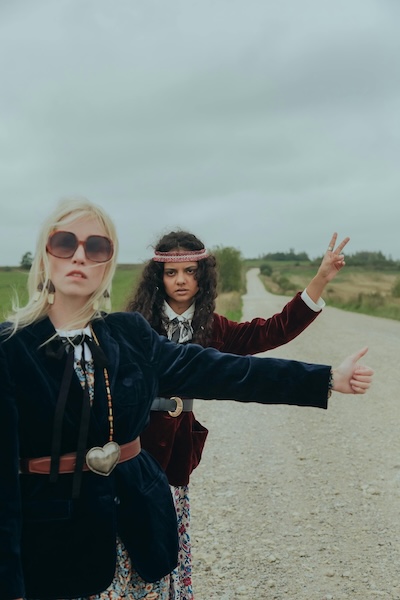
Late in spring, I was standing on a Baltimore freeway entrance, knots of heat sweltering up from the gritty edges of the asphalt. The stuff was crumbling, the cement-mix of it degrading by the hour under the blast and blare of a star, which soon, my old textbooks claimed, would run out of hydrogen and begin to die.
I stared up at it, the blazing yellow globe — no eye protection; that was a joke with the little I had — squinting on a blow-you-back highway in the middle of an airless and scorching day, standing next to Sonja Clay and two police officers.
It should not have been so hot — it was late May, a stone-skip of calendar hopscotches since the day I graduated high school, and we were — yes, we were — hitchhiking up the Eastern Seaboard. Me, nineteen, Sonja, twenty-two; thumbs stuck out, moving up the coast.
The cops found us on the south side of the city, hitching in — probably figured we were too young and too bone-headed to be doing this in the early 1980’s through places that were erupting with inner city uprisings, copper-coated bullets flying from drive-by shootings. But we didn’t have a clue. Not. One.
Sonja and I had been sheltered from news, television, newspapers — me in a dropout beach town diving into seawater of off-the-map, limbs-paddling, gay or straight explorations of myself; and Sonja, who I’d met in Virginia days after leaving the beach, had been hiding in the Blue Ridge Mountains, “living off the land” and “learning how to be a lesbian.”
There we were. Sonja. Me. On the lip of a freeway in Maryland. All I had was one pair of underwear (wearing them), a striped set of OshKosh B’gosh overalls cut off into shorts (from the Fleet Farm in central Wisconsin, where I grew up), one burgundy bathing suit top (under the overalls), one black wool sweater (too sweltering to even think about wearing), and a toothbrush, tucked into my OshKosh’s bibbed front pocket.
Sonja had less. Her John Denver wire-rimmed glasses, a pair of jeans, a T-shirt. No bra — she never wore one and didn’t need one, androgynous and proud of it. Boy haircut, puffy cheeks, un-sex-specified babyface, strong hands, a bright laugh.
Two damp sleeping bags tucked under our arms. No packs, no suitcases, no money — neither of us. Facing off with two Baltimore cops who wanted us off the edge of this freeway.
But there we stood.
Just our thumbs to guide us, our wits and the gall of being twenty-two and nineteen — Sonja, solid like an oak tree; me, all limbs and watchful, shrouded by a curtain of sun-streaked hair — deciding we’d trek state to state, because we wanted to; because we could.
***
We hadn’t planned to go with nothing. I hadn’t, anyway. It all started with a book. Tom Robbin’s Even Cowgirls Get the Blues, a romp of a story about women with courage and balls, one of whom — Sissy Hankshaw — had enormous thumbs that itched and twitched to hitchhike the American landscape. It was a cult story, birthed into a pre-1980’s world not the least bit ready for bisexual exploration, polyamory, gay life, freedom on the scale of who-gives-a-f***-who-we-sleep-with-or-how-we-identify.
And it was mesmerizing. Banned in hundreds of counties for being “inappropriate” and “deviant.”
I read it a few years after the book came out, when I graduated high school. In my yearbook, under “Seniors’ Ambitions” — a tame and censored venue, for sure — mine read: “Travel, sunshine, a house by the sea…” Between the lines of that vanilla-coated answer was this: I was dying to get away, to run. Cowgirls was my road map.
By the time I met Sonja Clay in Virginia, I’d been traveling with the book in my pack, holding onto it like a talisman, and I loaned it to her. She read it late at night by a candle propped into a hollowed-out tin can in her cabin, a rough-hewn pile of logs she shared with a handful of lesbian women. (She had her own grounds for flight — she’d been “caught” with a woman when she was seventeen and her parents had thrown her out.)
My reasons were just as solid and true. A family messed-with at our emotional roots, pulled up from the shaky ground by our very hair-tendrils, ripped out of the dirt by my father’s intransigence and sullenness, my mother’s flights away with another man and boomerang returns home, and a violently-fanatic set of evangelical church “elders” who, throughout my last two years of high school, landed on our doorstep at many a midnight hour, yelling in ear-splitting tones that me, my siblings, and my parents were going to hell. (The fact that my parents stayed in this church was way beyond me, even then.) Hollering and crying lined the rooms of our house like the green Fleur-de-lis wallpaper; doors banging on hinges became the backbeat of my days.
Enter the novel and the good soul who handed me the tome on graduation day. “You’ll like this, I think.” Art teacher. Friend. A woman who’d looked out for me.
When I read it, I had no reference point for any of the lives in it. Not the abandon, not the ballsy-ness, not the bright, blazing courage to live the way you want, because you want to. Still, I knew it when I saw it: the immediate click of something that spoke to my soul; a bible — my very own New Testament Revised Gold Standard of wildness and freedom.
I took off shortly after closing the last page of the thing, left home and hopped a Greyhound heading south from Wisconsin — “$55 one-way, across the country, U.S.A,” the company’s ad read (it rhymed) — visiting childhood friends who’d moved, and visiting no one, too. Just going. One driver took us through four states — Illinois, Indiana, Ohio, Kentucky — had chunks of foam on the floor so we could sleep, and stopped at truck stops, where we ate on blankets on the ground like we were on a rock ’n roll tour. Another driver in Tennessee said it was cool to smoke dope, but not cigarettes — something about the fact that grass was “too precious” and no one would ever let a joint turn into a burning upholstery fire.
When I stepped up the stairs of that first bus, I knew there was no going back. I didn’t want to — my parents were angry and bitter (I’d barely call from the road); my siblings were bouncing in and out of their house with white-knuckled grips, trying to gain purchase on any solid surface.
And I was in the world now, wanting — with all my might — for my life to be seen for more than surviving a familial train wreck; wanting it to be happily stamped with something extraordinary and unforgettable. Like Sissy in Cowgirls, with her huge and skewed hitchhiking thumbs — a girl raised in a poor suburb of Richmond where kids jeered and poked at her; where uncles and parents made fun — I was on my own ride now, an E-ticket out.
“When your own daddy sometimes makes jokes about you being ‘all thumbs,’ then you toughen up or shatter,” Sissy said. My ‘thumbs’ were my heartbreak, my lost family. I would toughen up.
Weeks later, I stepped off my last Greyhound route into a tiny Atlantic beach town near Key Largo, got a waitressing job, dropped out with other civilization-evading folks who’d come to slip out of one lariat or another — tanking marriages, corporate nooses, soul-pinching parental expectations, or the burdens of straight life on gay hearts.
There, whimsical people in street markets sold coarse rope bracelets and tie-dyed T-shirts and homegrown honey for cash, and no one had a “real job.” Friends sold tiny baggies of cocaine and weed and played in softball leagues sponsored by the restaurants we worked in. Everyone snorkeled. Even the mayor ran around barefoot and cycled through town in his Speedo. There was a guy I waited tables with — Harris — who I fell for in three hot seconds. Kind. Cut. Bushy black hair. Sweet and golden-brown, like that street-market honey, like the sweat on his beautiful chest in the humid heat that I would’ve willingly lapped and ingested, should he let me. I toppled for him, but he fell for sleeping with men. Then two women who were in love and notorious for fighting in public followed me around for weeks, trying to get me to have sex with them. I ended up in bed with my roommate, Jillayne, who fell for a man as I was tumbling for her, and in the midst of all of that, Harris and I became friends.
Harris told me tales of his Virginia life — what it was like to discover he loved men in a closeted, buttoned-up town that hated anyone who was even vaguely different. He told me he had friends in the mountains there — gay women who lived on a ranch of sorts, who came and went from road adventures and lived together.
“Like my book?” I asked.
“Pretty much. I’ve got a friend there named Sonja Clay. She loves the road, like you.”
Did I love the road? I had no idea. I was running, that’s all. Putting space between me and awful, seeing what my sea-legs were made of.
“Does she hitchhike?”
“Yep, she does. You two should meet.”
Days slipped sideways, Harris and I beach-surfing and dawdling, putting a pause in our lives. Months of doing nothing. He’d tell me about Sonja Clay, her hitching adventures — fat letters arriving in his mailbox from Canada or Montana or Maine. He’d read them to me in the sun, the two of us eating whole-wheat-and-cheddar sandwiches on stretches of sand, our rear ends cave-imprinting the grainy beach beneath us.
“She’s driving some hitching friends’ old school bus to Texas now. They’re living in the thing,” Harris read one sticky Tuesday. “Listen to this. She says she’s ‘holding the whole country’s landscape in her hands.’ Beautiful, huh?”
“I want to feel like that.”
One day, a year into our dropout life, Harris sat me down. “Gotta do something more than escape, girl. It’s the tick-tock of time. You feel it, I know you do.”
“But I’m just getting used to—”
“C’mon, sweetheart. You’re smart. College, at least. More than working for some tweaked restaurant owner smuggling bales of pot out of the Atlantic.” Harris was a few years older; he’d already been to school.
“But—”
Right then, it was the Reagan ’80’s, early spring, a blurry year so far, nothing hard or upsetting or uphill for either of us. But there was Harris, in my face.
“Time to go, babe.” His eyes went saucer-y on me, his go-to when he wanted me to dig in and listen.
We’d heard rumors that there was stuff happening up the Eastern Seaboard. Riots. Police brutality. Drug lords. Was there? We’d seen no news, no TV, no papers for four seasons — just sea and bicycles and cocktails and an occasional joint, waiting tables and journaling in the sun.
“Harris?” I squinched my eyes. “Do we have to?”
“You know I’m right.” He grabbed my hand.
“I’m not good out there.” I pointed north. “I’m not anywhere near what I ran fr—”
“I know.” He touched my forehead. “Listen. We’ll go together.”
“Yeah, but—”
“Trust me,” he said. “First, we’ll go see Sonja, then—”
“Really?”
He wrapped his arm around me. “Sure.”
I sighed, a big one. “Alright. You win.”
There was a thing then, a racket of sorts. We’d call a car-shipping company and for free we could drive some foolishly-trusting owner’s vehicle up through the Carolinas and into Virginia, drop it off, then head to Sonja Clay’s ranch. We’d pause at Harris’s folks’ house in Waynesboro, posing as girlfriend and boyfriend — “That’ll screw with their heads, for sure,” he smirked — then Sonja’s friends would come and get us. The car company — promising “licensed, bonded professionals who hand-deliver your fine automobile with exquisite care” — handed the keys over the minute they had a warm body who’d take the gig.
We got an Oldsmobile Cutlass for two weeks, new and bronze-colored, a slick, smooth skin of interior leather.
I’d had a hankering to hitchhike, but Harris wanted to go to Miami first — he’d heard it was a “gay mecca” — and the Olds’ would let us freely move north, get us through a city in better shape.
By then, my on-the-brink parents had sold their cafe in our Wisconsin lake town, hiding that their divorce would soon be final. I didn’t get it. Why the charade? Wouldn’t everyone in their church find out soon enough? My mother’s affair had ended, the man had gone back to his wife, but I’d heard from my sister that the walls were still shuddering from our parents’ outbursts.
In the Oldsmobile, Harris got us through the murky swamplands of southern Florida, huge cicadas the size of Midwestern June bugs flying through the car windows, slapping our arms. It was an infestation that year, piles of them crunching like breakfast cereal under our flip-flops when we stopped for gas and flapped our feet down. At one filling station, an attendant said, “Watch out in Miami. There’s crap goin’ down.” We’d heard nothing. That’d been our life; mainland drop-out days, or as Harris dubbed it, “Living the drop.”
Cruising into Miami, I read Sonja Clay’s last letter aloud as Harris surfed the big-ass Olds’ through neighborhood streets, bleached cement backroads like white-tipped waves in a sun spray, inching toward the city’s center. The heat was palpable, slick sheens of sweat glistening on our thighs in cut-offs, our underarms small lakes of damp. Sonja’s letter said she was home in Virginia, back from Corpus Christie where she’d been wearing Wrangler jeans, a buffalo-buckle belt, and cowboy boots — posing as a guy. “Shit-sure, easy as hell, Harris,” she wrote. “I’m getting a Stetson.”
But driving into Miami, something was off.
The place was a ghost town. Not a car. Not a soul walking. Streets deserted, windows shrouded and covered. We had no map, winging it; putt-putting through arteries of cartoon-still houses.
A quick prickling ran up my legs. “Harris. Something’s wrong. You’ve gotta get us out of here.”
“Shit — I know!”
He took a sharp right, slammed on the brakes in front of two barricades — and twenty national guardsmen in camouflage. The sound of the Olds’ ticking engine flipped their heads, and in a hot rifle snap, they jumped our car.
“Get out!” one shouted. “What the hell are you doing down here? There’s a curfew!” It was five-thirty in the afternoon.
Guns pointed our direction.
“Oh, friggin’ hell,” Harris hissed as we crawled off the muggy seats.
In a sticky situation, I freeze. I go stoic. Later, I melt down. A survival skill, from my family’s house. Now, we stood facing the guardsmen; I smoothed my sweaty long hair, trying to look serious and innocent.
The guardsman nearest us twitched. “There’ve been shootings! You guys didn’t hear that? It’s been all over the—”
“We were just—” I stared at his machine gun, his fingers gripping the waffled side of the thing, triangular butt stuck up against his hip.
Harris grabbed me, pulled me in. “Look, we’ve been at my folks’ vacation home,” — him, trying for hints of money, class. “No phones, no TV—”
I started to cry, couldn’t help it, standing stock-still with my face instantly wet.
“Oh, Christ,” the guardsman said, watching me. “Get in your damned car!”
He led us out of the curfew zone to a freeway entrance, and as we inched by him toward the ramp, Harris angled to my open window and yelled, “Thank you!” The guy rolled his eyes and waved us by. “Just go, okay?”
I started shivering on the freeway, a wicked shimmy in the center of me. My teeth chattered. “I hate guns,” I said. “They make me —” I couldn’t stop trembling. Tears burned at my lash line.
Harris’s eyes went wide. “But you were so cool back th—”
“I wasn’t. I was—” My head spun, molars clunking.
Harris gunned the gas.
“Go slow!” I yelled.
“Darling, breathe. You’re gonna pass out!”
“I can’t — I’m…Harris! Why does everything have to fall apart?” I cupped my hands to my face, gasping into them.
“Hey—”
“I don’t belong anywhere!”
“Sweetheart! Remember? The Blue Ridge Mountains? Sonja Clay? We’re going there! Her and her friends — their ranch. It’ll be just like your book, okay?” It was a distraction. Harris’s left hand gripped the wheel, his right grabbed my thigh. “They’re gay up there — lesbians.” He hissed the words out hard, like they were shocking. “Divergent women. You don’t care, do you?”
I smirked through my tears. “Very funny.”
“Seriously, if I can make you giggle…” He squeezed my hand. “Six of them in that cabin. I told you, middle of nowhere. They’ve got a horse, a bunch of chickens, a garden.”
I eyed him. “You said we weren’t supposed to drop out anymore.”
He laughed.
I calmed right down, though. He knew how to do that to me, make me come back to myself when I was squirrely or agitated, when I started thinking about my falling-apart family. He was a good friend.
“How come you never call her ‘Sonja’? It’s always ‘Sonja Clay.’”
“Don’t know. Everybody calls her that. I named the place—”
“Named what?”
“Their cabin. Rancho Lesbiana.”
A guffaw erupted out of me.
“Still wanna?” Harris said.
I breathed, suddenly able to take in air. “The real world is too much for me, Harris. Let’s go.”
“Just a few days with my parents and then the Blue Ridge Mountains. Okay?”
I nodded.
***
We dropped the car in Charlottesville, got ourselves to Waynesboro where Harris’s parents lived — separate bedrooms for the two of us, of course. His father was gruff and silent, eyes cocked, not falling for the boyfriend-and-girlfriend thing, not by a longshot. I would turn twenty in weeks, but even then, I could smell disapproving parents at forty paces. His mother moved like a curious mouse, nose quickly wriggled in then yanked back, stark and jolty bits of conversation, erratic and suspicious. It was clear they did not understand their son. He, too, knew their prejudices and stayed back. But it was the first of something for me: a recognition that parents often already know something about their child — Harris’s propensity for men, in this house — and refuse to talk about it, will jones themselves up on denial, talking ’round and ’round the elephant until all that’s left is blindness and distance. I had it in my own family: hiding, pretending, lying — the expectation to cover, just to get by. I could taste the familiarity of the blot-it-out drug on my tongue at Harris’s.
A few days later, Liv, Harris’s friend at Sonja’s, came to get us, had driven two hours, pulled up in a beat-up 1970’s pickup truck — a faded yellow paint job with a cracked crater over its left wheel well, as if the driver had side-swiped a meteor the size of a children’s wading pool.
“Yeah, well, that’s mountain life,” Liv said when Harris’s mom asked about the dent.
Harris’s parents stared at her. Pretty, petite, no makeup, no bra, men’s painter’s pants sitting low on her tiny hips, work boots, a thin white muscle shirt and breasts completely visible through the fabric. Ponytail. Stunning biceps.
Disapproval flew through the air like flying knives, pinning Liv in place.
I said thank you to Harris’s parents, gave them each a pert hug. He shook their hands — no hugs there. Where was it just warm in families? Accepting? Kind?
Liv cocked her head and said, “Well, hell, we gotta go!”
A couple of winding-road hours later, we landed in the cabin’s driveway. Dirt, rocks, sink-sized potholes. Chartreuse weeds in a welcome of knee-high waving combed the edge of the drive. I’d been singing that old John Denver tune, Take Me Home, Country Roads, over and over, and Liv and Harris were ready to shove me out of the truck.
I started in again, “Life is old there, older than the trees…”
“Oh, good God, Liv. Lemme out!” Harris yelled, swinging the metal door, the truck coasting in.
And there it was. A two-story, Lincoln-log box of a thing. Old. Weathered. Chimney, log posts, dirt-covered windows, a wide wooden porch. A dusty corral ribbed the cabin’s side flank, tin roof atop a horse shelter. Three beater cars and an old Ford station wagon were parked in the yard like French toast halves in a pan.
Five women came running out of the house. I would’ve known Sonja Clay anywhere. Harris had told me, “It’s an is-she or is-he thing, with a heart that comes at you like a giant beach ball.”
Harris had written that he was bringing me, no phones out here. In two hot steps, Sonja Clay was off the porch, lifted me up, my body pressed against her chest and feet dangling. I saw a wash of fleshy arms, clipped white-blond hair, baby-pale skin, sea-green eyes. “Well, look what Harris brought us! A girl. What’re we supposed to do with this, Harris?” She was grinning, had her cheek up against mine — not sexual, just a welcome so warm that I felt my eyes well.
Harris was in the arms of four women — Callie, Jude, Chris, and Maria-Therese. I was quickly introduced: Callie, basketball tall with pointed features; Jude, a bowl haircut over supple, short limbs; Chris, willowy, long-legged, spiky red haircut; and Maria-Therese, a shiny, brown-skinned beauty with waist-long hair and I know you eyes.
Sonja grabbed me again and shouted, “We’re spit-licking glad to have you here!”
A little eruption from me, then all at once, a waterfall.
“Honey, she’s crying!” Sonja blurted to Harris.
Suddenly, all seven sets of arms were around me. Kisses landed on my head and back, my hands were held, giggling feminine voices surrounded me. Harris softly laughed. I caught a glimpse of the sun tendrilling over the rolling mountains through my blurry eyes, fingers of gilded warmth that found our limbs and the part-lines of our hair. A horse whinnied nearby; an animal rustled in the brush.
It felt like a home.
I tumbled to my knees, crying hard now — a tipping point of kindness, all of these hands and arms holding me — being wanted in a house, being expected and looked forward to — palms upon me, soft voices, “It’s okay…” “Just let it out…”
When I was done, I stood, and we ambled into the house. I wasn’t made to feel bad; I wasn’t embarrassed. I was humbled. Somehow, in this off the map ranch, with these women and Harris who would not judge me, my heart had egg-shelled apart, had left its hard-boiled facade in the loose dirt of that driveway, opening up.
Weeks passed, sweet and long, in the warm embrace of new friends. Meals made, vegetables yanked out of a ragtag garden, simmered brown rice and a baked chicken from the chicken coop, squash roasted with hot sauce. Baths in an old white tub propped in the yard, a firepit nearby to heat the water. No electricity, candles in cups and smoke-covered glass kerosene lamps. An outhouse that Sonja Clay cleaned with a high-powered hose connected to a well.
She and I had been out walking every day; her voice calmed me, her spirit made me easy.
“How come you’re so happy?” I said one morning. “I mean, your parents—”
“They’ll come around. Or maybe they won’t. But their thing is their thing. And I’ve got my thing.”
“But doesn’t it hurt—”
“Can’t live like that. Have to live in the love. Find it, live in it. That’s happy. Let everyone else get there on their own time.”
“Even your family?”
“Even them.”
I wanted that blind trust in life.
One balmy evening, I was helping make chili, and from the loft behind the kitchen, I felt something fly my way — a small object.
“Jesus, God!” I yelled.
It was a tampon, slightly pink — used — flying four inches past the pot of chili.
Sonja Clay was right next to me, chopping onions, and she cackled when it landed on the floor. “Oh, come on, girlie! It’s baby-making blood! Sterile as anything on the planet!”
She reached over, picked it up, dropped it in a paper bag.
Liv yelled from upstairs. “Sorry! I was aiming for the garbage!”
“Liv likes to pull them out of Callie with her teeth,” Sonja Clay whispered.
“She does not! That’s gross!” I quipped.
“Not if you love women.” Sonja ribbed me with her elbow. “They’re up there getting it on.”
That stopped me in my tracks. No doors, no hiding away. I didn’t know if I was shocked or fascinated. I heard the low murmurs of lovemaking from the back corner of the loft.
Sonja Clay flipped the stove off. “Let’s go for a walk.”
We headed down the one-lane country road, no-see-ums and bees batting around our heads, me in my flip flops, Sonja in her half-laced work boots. Grasses grew high on either side of the rocky asphalt, a slope leading farther up the dark-hued mountains.
“I read your book.” She ran her hands through her hair, spiked up the short ends. “It’s kinda like us, out here, yeah?”
“You liked it?”
She stepped faster, I had to keep up. “I like you. But you won’t be staying.”
I’d thought about it — staying; had felt her feelings, too, wondering if deeper things might be between us. It was a life I’d never thought of, the lesbian thing so new for me, her gender fluidity and these women’s self-sufficient country lives, the courage it took to live this way. And Sonja’s heart just out there, a corral that’d been flung open, a whole stable of delicate, high-spirited horses left to run free.
“You got a letter,” she said. “Harris told me.”
A friend had written, said she had jobs for me and her on Cape Cod, a college kids’ bar called Rascal’s in West Yarmouth. If I wanted the gig, I could stay with her, but I had to show up by the first of June.
“I don’t know if — I don’t even know how I’d get there.”
“So, you’re done adventuring?”
I flashed her a look.
“That’s what I thought.” She turned and faced me. “I’ll tell you what. You wanna hitch sometime, right?”
“I—”
“Do it now. I’ll go with you. I’ll get you up there, and you come back someday and see me. Okay?”
“You’d — I mean, for me?”
“Harris is gonna be shit-stirred, but he’s got to get himself to a city, and soon. Someplace with a gay scene. We’ve all got our paths, girl.”
When we got back to the house, Harris was sitting on the porch. I waved, crossed the yard to the outhouse. When I came back, I sat on the weathered boards next to him, dangling my feet. He looked sad, lifted my hand. “There’s no place in the world I feel this easy. You?”
“No.” I sighed. “But you’re the one who said we needed to—”
“I know. Hey. Sonja told me. You guys are hitching to the Cape, huh? When?”
“I don’t know. A week?” I felt miserable leaving him. “Harris, I’m going to miss—”
“I know you will.” His eyes shot my way. “When you’re done, I don’t want you coming back here.”
Tears stung under my lids. “Why not?”
“You’ve gotten your wild-ass thing. Me, too. Now we’ve gotta figure out our lives.”
“Sonja says you need to find a gay city. Like, soon. Says you’ll never be happy hiding out in a place like this.”
He blew air out of his chest, hard. “She’s right.” He looked up at the oak trees in the yard, his eyes river-full.
“Where? Miami?”
“Don’t know. Maybe.” He slipped his arm to my shoulder. “Come ’ere.”
I scooted over, our thighs touching.
“Listen. Tell me something,” he said.
“’kay.”
“How’d you do in school?”
“You mean grades?” I looked down, avoiding his wide-open gaze. “A’s. All through.”
“So why didn’t you—”
“My family was falling apart.”
“Nobody asked if you wanted to go to college?”
I laughed, a short burst. “That wasn’t on anybody’s radar.”
“Okay. You make me a promise right here. You do this thing this summer, and then you’re done. You find yourself a nice, warm place — some loose, hip town — and you go back to school. You hear me?”
“Harris—”
He leaned in, put his arms around me. “Do it for me.”
I wept there, cradled inside his limbs, knowing he’d be gone, I’d be gone, and soon. I pulled him in, my brother, my friend, and held on like he was the last loving thing on earth.
***
Two days before Sonja Clay and I left, we all dropped acid. Liv had little tabs, and we swallowed them with room-temperature chamomile tea. “Easier on the stomach,” she quipped.
“We’re taking a journey!” Sonja Clay hollered after we’d all downed them.
We spent the day lolling in the yard, the almost-summer, mid-May ground warming us from underneath sparse grass. No blankets, our bodies lying back, looking up through a cascade of branches, budding green growths popping their tiny heads out of a seasonal rest — the gorgeousness of God in renewal. The green was singing to me, the pulse inside these trees a lyrical line; the simplicity of it — so regular, so normal — and the mystical arc of its sublime notes, too, an ethereal song written just for us. We lay there for hours, leaning against each other — all eight of us — barely talking, drinking vats of tea, being there.
Sometime around five, the clouds came in fast and dark, gray hoverings over our supine selves, a sharp, hot-pink ridge of clear at the Blue Ridge horizon line. In two seconds, it was pouring like mad, a pulse of ratta-tatta-ratta-tatta, sharp and puddling everywhere, all of us soaked.
Sonja Clay got up, laughing, and grabbed my hands. “Come on!” She ran with me to the corral, the angled slope of it now a mud-slicked mess. She yanked her clothes, naked in a heartbeat, and then we did, too, all eight of us bare and giggling, water pinging our breasts and asses.
Harris yelped, then ran, slid his rear end in the watery mud, the slope of the land now a slide, a skin of muck coating his lovely form. Sonja ran, too, dove in flat-breasts first, rolled in it. “Oh my friggin’ God, I love Virginia!” Then we were all in, slithering and skidding, tumbling, skating — high, whole and happy.
It was probably only moments, but in our sweetly-altered state it felt like eternity had touched us, perfect and exquisite. My heart lifted up, each of us flapping our arms in the mud, ground-borne flights from this land where we could be ourselves, and be free.
Later, as the rain wrung itself out, we were rolled together in a huge lump in the wet mud, layered upon each other like chicken breasts in a Value-Pack, smooshed and sauced with soft dirt.
If I had written it all in a fictive bit of longing for freedom and connection, like the book I loved — these women wildly living out their lives on their own ranch — I couldn’t have scripted it more flawlessly.
Harris got up and wrapped his mud-caked body around mine. “Remember this,” he whispered.
***
Sonja and I took off, weathering five sweltering days of hitching. But it was the second morning that would have done me in, had it not been for her.
We’d both left with packs — me sniffling all morning after saying goodbye to Harris — a rucksack for her, a pillowy hiking pack for me. Two sleeping bags, maps, jackets, jeans, socks and T-shirts, a few lightweight skirts “for the girl,” Sonja said. Tennies, sandals. Toilet paper, soap, a towel each. I had almost four hundred dollars in cash from my waitressing money in my pack’s zip pocket, Sonja’s two hundred in there, too. That was it — no bank accounts, no cards, no backup. My pack was all I had in the world, that and a couple boxes of clothes in Liv’s closet back at Sonja’s that they’d send when I got settled.
The first day was an easy ride from a mother with a boisterous laugh and a zany, black-and-white streaked hairdo who cackled for two hours heading through Virginia. Nothing scary; nothing tense. Sonja had stuck out her thumb, and the woman had stopped. Simple. Then a guy in a flatbed, us in the back with our packs.
The two of us awoke the next morning in the woods, bedded down behind a rest stop from the night before, and someone — likely the guy who dropped us off — had stolen our packs. Doubled back from his flatbed, searched for us in the trees, and three feet from our sleeping heads, took everything we had. Gone. Vanished. Even our thermos of water. Lifted off the face of the earth and — poof. God knows, it could’ve been worse (though Sonja had mace and a knife in her pocket in case), but I was out of my sleeping bag in two seconds, melting down.
“Jesus fucking Christ, Sonja — what the hell are we supposed to do now?”
I couldn’t call home. I could try, but the likelihood that my parents would holler instead of help was too much to bear. I wanted Harris, our tranquil, untroubled beach life in Florida; I wanted to go back to the ranch; I wanted off this damned road trip.
Sonja had no family who’d help, either. Liv and the gang at Rancho Lesbiana, yes, but she wouldn’t call.
“You won’t call? Are you kidding me?” I snapped. “Why the hell not?”
Sonja Clay was cool, quiet.
“We haven’t got any money! How are we going to eat?” I was heading straight into an anxiety attack, my breathing rasping in tiny thimble-gasps.
Sonja walked over and hugged me, but I pushed back. “That’s not going to help!”
“Neither is freaking out.”
“I’m not kidding! I can’t call home — I’ve got no one!”
Sonja sat down on a rock, caught my eyes. “You’ve got yourself.”
“What’s that supposed to mean?”
She pointed to my chest. “Inside. You’ve got—”
“I don’t need a friggin’ life lesson right now! I need to know what the fuck to do!” I’d been sleeping in my burgundy bathing suit top and underwear, cut-off overalls stuffed into the sleeping bag, a black wool sweater in there, too, my tennies under my head. I threw the overalls on, shoes, grabbed my sweater, stomped off. “God fucking damn it!”
Sonja Clay didn’t chase me, didn’t call out.
I walked fast, jamming my heels. Even my goddamned clothes are gone, for fuck’s sake! Why can’t I hold onto anything? I kicked a rock the size of a golf ball; it bounced and smashed into my bare shin. “Shit! Jesus!” A plum-sized purple bruise spread like bleeding ink under my skin.
Twenty minutes later I came back, sat next to Sonja on the dirt. “Sorry.”
“It’s okay.”
She got up and I followed, heading for the freeway. I started crying. “Why does everything have to fall apart? I mean, everything! Nothing sticks to me!”
She turned and put her hands on my shoulders. “We’re going to trust, girlie — that’s what we’re gonna do. And you’re going to learn that the shit that went down in your family has nothing to do with you.”
My mouth dropped open. No one had ever spoken to me this way. How the hell had she learned all of this?
I paused, too frightened to push back. No food, no water. No cash. Nothing but the clothes on our backs and each other — a toothbrush stuck into the bib of my overalls.
Sonja turned to the road. Her thumbs twitched and rolled on the highway’s edge, she smiled her sweet smile and waited.
Hours later, we were sitting, butts on gravel, taking a break from standing with our first-digits pressed out. No rides. I hadn’t planned on the gaps in-between, the endless standing and thumbing it took to get someone to pick us up. The sun was blasting like the light bulb inside my childhood Easy Bake Oven, cooking us like pieces of yellow cake turning pink. We’d barely spoken all morning.
“Time does this thing,” Sonja said, chewing on a piece of dead grass.
“What do you mean?” I was brooding.
“It unravels things.”
Trucks were flying by, bright blasts of air pulsing into us when one came close, split-seconds of cool.
“I’m never going to forget what went down in my house,” I said.
Sonja looked out on the road. “Yeah, but don’t keep reliving it. Find something else to live.”
“You think it’s okay if I choose a – like, pick a place, go there and–”
“Yeah, I do. Just because you want to.”
“But—”
“Look. The parent-thing will settle out, or not, and if there’s still a fire burning down their houses, you get to choose how close or far away to stand.”
I teared up. “I want to belong somewhere.”
“You will. But just like your Cowgirls, make it a place you want to be.”
I stared, felt something wash over me. A trickling of courage moved in amoeba-shapes through my insides, and I stepped up and leaned into the rush of cars. My arm found its way into the air, thumb stuck out.
Sonja came and stood next to me. A car pulled over, a beat-up Dodge Challenger, the driver beefy and bearded with a six-pack on the seat and an open can between his legs. He yelled through the open window, “Where ya goin’?”
Sonja angled near and smiled. “Hey — sorry to make you stop, but we just figured out we need to go South. Have a great day!” She turned, and under her breath: “Follow me — fast.”
We tramped away down the freeway ramp, clouds of dirt under our shoes.
Ten minutes later we were back in our spot, pitching our feet on the highway’s edge. And it was there, kissing the edges of that Maryland highway in my dirt-covered tennis shoes, my thumb surrendered to the road, that I started to feel it. The power in simply standing there, in being alive, being able to choose — where I went, how I lived, who I let near.
A grandmother in a denim jumpsuit with wild hair and tiny hands swerved over quickly — “What the hell do you two think you’re doing? Get in, for God’s sake!” — and we laughed, told her our story. She drove us an hour out of her way. A vending machine salesman, a father, pulled up next in a bulky, open truck with a half-dozen of the metal contraptions strapped into the truck’s bed, then put us up in a motel, paid the bill and left. In the morning, a forty-year-old woman in beads and a leather vest stopped in her Karmann Ghia, me sitting between Sonja’s legs in the two-seater, told us she’d met Janis Joplin hitching with her boyfriend to California in 1970. She fed us, gave us forty bucks.
Later that day, the cops showed up, us standing with nothing but the clothes on our backs on that Maryland freeway entrance just outside of Baltimore, certain they’d arrest us with their swirling cherry-red squad car lights. But instead, they took us to their clubhouse in a little suburb called Ellicott City, brought us dinner, let us take showers and laid out cots for us to sleep overnight. The next day, they drove us fifty minutes north to a freeway entrance in York, Pennsylvania — “Safest exit as we can find” — then handed us vials of pepper spray. One of them, Pete by name, took my hand when we left and gave me his card. “You call me if you need anything. Understand? Call collect.”
Every ride, every kindness, gave me a tiny bolstering of faith — a feeling like lying back in a burbling creek in my Wisconsin hometown, letting the waters rush over me; a flat, smooth rock beneath, holding me up. Now, here, with the cloudless sky above us open wide on these unknown roads, the bright blue of it felt like a home for a force of life that might guide and show and care. Even if it didn’t look the way I thought it would look.
I said as much to Sonja.
“Good, girlie,” she said, grinning. “Now, let’s get there.”
***
Days later, I left Sonja Clay at a tiny bus station across from a mattress store in Hyannis on Cape Cod — a nothing little stop with a metal sign hanging off a lamppost, a stucco kiosk and a cordoned-off parking space next to a patch of grass. Sonja would go back to the Blue Ridge Mountains, and I’d stay and try to figure out my life.
I stood on the grass at that street-side station, holding her, the giant silver animal of the Greyhound heaving plumed and ashen exhales from its exhaust pipes.
“You give up that head-talk — ‘No matter how hard I try’ — okay? You go out in the world and live. Like that book you love.”
I nodded, crying. “You, too.”
She brushed strands of hair out of my face. “And write to me. Harris, too. He’s gonna miss you like crazy.”
I watched her wave from the bus window, and she grinned at me, blew me a kiss.
As the bus faded from sight, I got down on my knees, then pressed my lips to the budding grasses, kissing the ground she’d stood upon.
JoAnneh Nagler is the author of the award-winning books, Stay with Me, Wisconsin; How to Be an Artist; Naked Marriage and The Debt-Free Spending Plan, two of which were Amazon Top-100 titles. Her work has been featured in The New York Times, Cosmopolitan, The Huffington Post, Medium.com and in many literary journals.
 ELEVENTH HOUR LITERARY