
Shortly after my son was born, I began stealing self-help books. What started this sudden stealing, this seemingly unstoppable shoplifting? Why did I, a reasonably respectable, rather intelligent, faintly middle-class new mother, take those books secretly at Second Story Books, at Aunt Violet’s Attic, and at Twice Sold Tales? Why did I surreptitiously slip those paperbacks into the green-and-white diaper bag I carried over my shoulder, hide them under the football patterned receiving blanket, or slide them behind my baby’s back in his striped Greco stroller? I stole, yes, I did, it’s true, but the question I ask myself now, more than thirty years later, is, out of what hunger, out of what need?
And if I was going to steal, why did I steal self-help books? Virginia Woolf lover that I was, why lift this pablum-of-the-mind when I could have been taking that shiny new copy of Mrs. Dalloway or at least the newest edition of her diary? What was the allure, in those days, of Feel the Fear and Do it Anyway and The Anger Book and a second-hand copy of How to be Your Own Best Friend? And why did I need so many of those books? During the period of my life I’m describing, the blessed year of 1991, the year I lived in a ratty two-bedroom apartment on Woodland Park Avenue in Seattle with my husband and my tank of a blue-eyed boy, I took books almost weekly, bringing them home to hide in the baby’s room so my husband wouldn’t catch on to my compulsion. I’d stash a couple of books next to the rocking chair where I nursed my son three times a night, slip a few more under the crib mattress and lean others against the wall beneath the Il Trovatore poster and the fierce inflated brown-and-white pterodactyl that dangled from a string.
Soon it seemed to me that the self-help books were taking over our apartment, sliding out from under the crib mattress and making their way into the living room in the middle of the night. They’d tumble off the coffee table onto the thin gray rug where they’d lie, exhausted, under the dying hydrangea swinging in the window. Sometimes they’d find their way into my bedroom, creeping onto the futon where I caught a few minutes of sleep: Creative Visualization and The Road Less Travelled and Love is Letting Go of Fear half-open on the pillow next to me. I imagined one of those books — Sex: If I Didn’t Laugh, I’d Cry, maybe — drooling a little on the pillow, snorting and rolling over, slapping its pink dust-jacketed arm over my shoulder in its sleep — a shapeless kind of warmth, a cool kind of intimacy, safe, not the complicated closeness I had just then with my husband, supporting our family by working sixty hour weeks at Boeing, sleeping alone on the couch, stuck in his own postpartum sadness. Whatever was the matter with me?
Since those days, I’ve learned a few things, and I’ve forgiven myself for that brief period of compulsive criminality. Sometimes, I’ve learned, we make the wrong choices. Sometimes, when we feel inadequate, unmoored, lost or angry, instead of reaching out to other women who might understand, and in the solace of conversation, offer reassurance or insight, we choose to eat too much cake or drink far too many glasses of wine. At other times we choose to shoplift. And what we shoplift, when we feel that way, is what we think we need. Which in my case was help. Lots of it.
***
On pretty Seattle days — sailboats, trawlers and houseboats rocking on Lake Union; scone-selling cappuccino lady near the Safeway up the street; rhododendron and azalea blooming everywhere — I’d clatter down our apartment’s long cement steps, swing my four-month-old, my first and only child, into his blue-and-white striped stroller, tuck an afghan around his cheerful little body and off we’d go, on a jaunt through the neighborhood. We’d push by bungalows with big porches and down 45th Street, past the Wallingford library and the old Food Giant. We’d rattle under linden and cherry plum trees to the park where children in My Little Pony rainbow-light-up-sneakers slid through tunnels or swung on tires or wobbled across bridges at the Wallingford Playfield.
Standing in the muddy spring grass, fuzzy-headed from lack of sleep, I’d wonder how I came to be among all these children, with spit-up trailing down my shirt. This was not who I thought I was: that familiar, bookish self — the person with two master’s degrees — had melted away after the high of giving birth, after my realization that this squirmy little squirting mess depended entirely on my devotion for his survival. Clumsily maneuvering the stroller, diaper bag, teething ring, changing pad, spit up rags, baby wipes, and Sandra Boynton board book, I’d settle myself on a park bench to watch the children bothering their nannies, my co-workers in the mother trade.
Musing over what I wanted for my dignified little son and all I’d learned I was too limited to provide, I’d pat the pink plastic whale tied to his stroller and watch him watch it swing. Then, so quietly even I hardly noticed where we were going, we’d roll towards the bookstore.
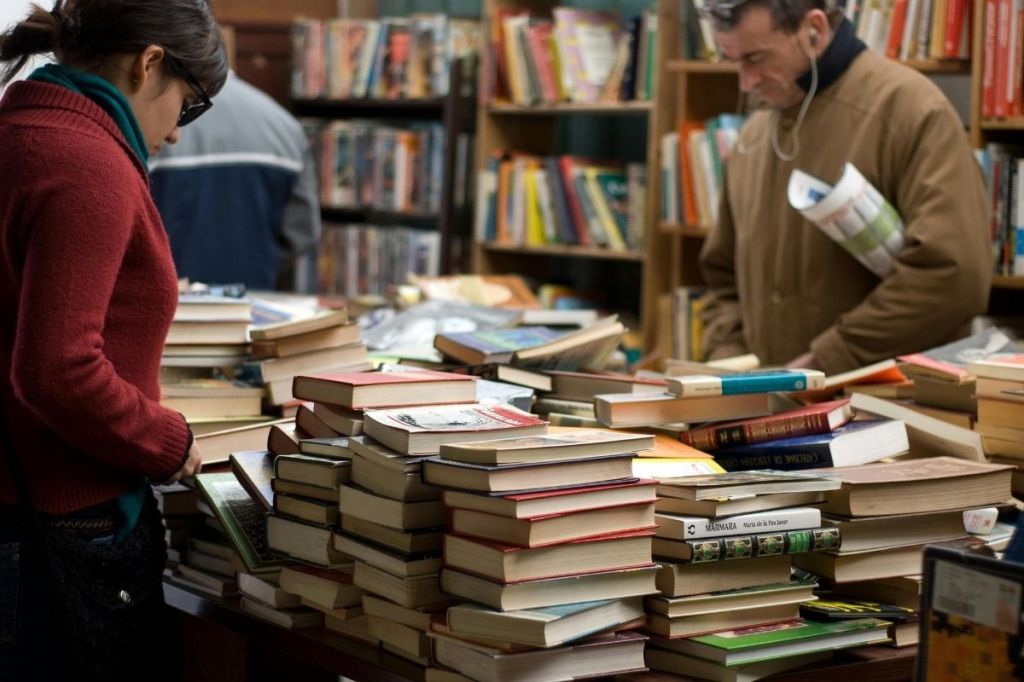
Bright, clean, and expensive, Second Story Books reminded me of all the bookstores in all the movies I’d ever loved — The Big Sleep’s cluttered Acme Bookstore, where Bogey shares a bottle of rye with a smart and beautiful bookseller one rainy afternoon; Vertigo’s antiquarian shop, The Argosy, with its dark wood and glass cases, where “Pop” the proprietor tells Jimmy Stewart about the mysterious beauty Carlotta Valdez; and the uptown place in Crossing Delancey, where Amy Irving works when she meets her pickle man. Sunny windows stretched along shiny walls at Second Story Books and carpeted stairs led gracefully to landings where, behind wooden railings, volumes of poetry were deliciously displayed; booklovers in mountain boots sipped skinny lattes as they discussed Bridget Jones’ Diary or The Good Rain and life was as it should be, as I had thought it would be for me: calm, secure, orderly — and full of books.
Salespeople at high-class bookstores don’t expect brown-haired, blue-eyed respectable looking middle-class moms to steal. Even sloppy, sleepy moms — as I was, with shirt untucked and jeans torn at the knees — don’t seem worthy of suspicion to the bright young people who work among the tomes. Wandering through that sunny place I’d tell myself I was just looking, really, this was just a break in my day, a way to get outside, something to do with the baby, a little time in a bookstore. I wasn’t going to do anything wrong, really. Really, I wasn’t.
At the same time, I’d carefully note where every Microsoft millionaire, every opera aficionado, every salesperson stood. And sure as the moon rises over Mount Rainier, I’d find myself picking up a book — there, on that round table — and running my hands over its brand-new part-cloth cover. Thinking of the diapers I’d swished in the toilet that morning, the dried-up Earth’s Best rice cereal crusting on the kitchen table, the soreness of my nipples and the full night of sleep I thought I’d never, ever experience again, I’d gaze longingly at those clean, bright, paperbacks, those shiny black and green spines lined up in rows, those sharp-edged covers that felt cool and familiar — books displayed so prettily on the table in front of me, books which, at that point in my life, I had no energy to read — and I’d think, I need these books, I deserve these books. And then I’d think, really, that my baby needed them, too.
I’d tuck the pearl-white afghan around his little body and tug at his green-and-blue cap to make its tassel swing. I’d wander past copies of A Room of One’s Own and Rachel and Her Children, by the bookcase marked Women’s Studies and the one called Political Philosophy. I’d resist, resist — then head toward Self Improvement.
Why Self Improvement? I’d learned, since my baby’s birth — in the harshest way possible, I thought — that my Self needed Improving: The voices of those writing pediatricians, Dr. Sears and Dr. Spock, T. Berry Brazelton and Richard Ferber, sounded in my ears all day, every day, explaining how inadequate they found me. My feminist sisters found me unworthy, too, I was sure. Unwilling to leave my job in public relations at Seattle Opera but unable to afford daycare, I’d tried to work at home while caring for my infant, propping him up on my lap as I typed summaries of Rusalka and Werther; or nursing him as, sitting on the floor of our apartment, I interviewed set designer Gunther Schneider-Siemssen on the phone. Finally, I’d resigned my position and then fallen flat, becoming a person I couldn’t feel good about, a feminist financially dependent on her husband.
I needed help and felt ashamed of needing so much of it. But if I needed the insight and advice those self-help books provided — in those days before information was available on the Internet — why steal? Why not buy the books, or borrow?
Truth be told, stealing satisfied. When I took a book without paying, I wasn’t just any old mom, that stroller-pushing creature people saw, that floppy befuddlement that made sentimental strangers smile. Instead, I was an outlaw with a purpose, a goal; I was a perverse version of the mother ideal, taking rather than giving. Every time I took a book I didn’t pay for I was getting away with something; every time I took a book I was, for a few moments, getting away.
***
Motherhood, it turned out, was confusing, more confusing even than the impulses that came over me in the bookstore. I’d been looking forward to becoming a mother for a long time — since the day I unwrapped Alice Dalgliesh’s The Silver Pencil inscribed with my own mother’s words: “This is a new book to me. Tell me how your interest holds up. Also, how does the mother character develop?” Since then, I’d been comparing my own blonde, bossy mom — a woman who would always rather have been reading — with the women on the page: my real mother always fell short. Wasn’t Little Women’s Marmee, a “tall, motherly lady, with a ‘can-I-help you’ look about her which was truly delightful” kinder than my own mom? Why wasn’t my mother domestic, like All-of-a-Kind Family’s Mama, who held Purim parties and thought up find-the-button games to help her daughters learn how to dust? My own mother would never resemble Dickon’s “comfortable wonderful mother creature” from A Secret Garden, who told her son that skylarks sing the Doxology when they awoke each morn. When I became a mother, I decided at eight, I’d behave the way the moms between the covers did: I’d build fancy dollhouses and pull together parties for my many children; I’d allow other people’s kids to come to my house whenever they liked. I’d certainly be more attentive than my own mother was, her nose always in a Josephine Tey or John Le Carré novel: I’d never be frustrated, isolated, and grouchy, as she so often seemed.
So many years later I found myself frustrated, isolated and grouchy, rolling my son’s stroller into bookstores, gazing longingly at the paperbacks, yearning to read. More than work, more even than money, I missed my mind. It seemed it had turned to mush when my son was born, as everyone I knew had warned me it would. Before his birth I’d told a friend that I was reading The Brothers Karamazov, reading in the same concentrated way I had in graduate school, except that this time, my due date was the deadline: my mind and body in competition to see which would end first, Dostoyevsky’s novel or my pregnancy.
I never finished The Brothers Karamazov. My son was born before I got to those final chapters, and then I changed. With my boy on my lap, I watched Anita Hill’s testimony against Clarence Thomas; I watched her tell the country what some women endure at work; I saw how no one took her seriously. With my boy on my lap, I listened to the bombing of Iraq. In response to the world I saw, I wanted a different kind of book, one with soft, gooey, friendly words; words that had nothing to do with serious, nuanced ideas but ones with simple, soothing, hopeful answers, preferably in words that rhymed.
***
This was not what I was raised for, this life of stealing, of depending on the sometimes-simplistic wisdom of self-help books. My husband, the orphaned son of lower-middle-class Jews, had grown up with little sense of security, but my upbringing had been quite different. My father, a professor of religion, raised me in a house in which Books Mattered, in which Words Mattered, in which language, language done well, was the Stuff of Life. My parents’ ivy-covered Victorian overflowed with books. Knocking out the frosted-glass doors between the parlor and the living room, my parents installed floor-to-ceiling shelves — one whole wall of green-brocade-backed Dickens and 10-cent-Depression-era paperbacks; part-cloth Vintage copies of Willa Cather’s works, my mother’s high school Edna St. Vincent Millay, the wood-cut illustrated copies of Wuthering Heights and Jane Eyre that I loved; and all of my father’s Bibles: the blue concordance; the black leather-covered book he occasionally preached from, with its red ribbons to hold his place at just that particular psalm; the little leather New Testament he’d purchased in his twenties, and the hardback Revised Standard Version his father gave him when he earned his doctorate from the divinity school.
There was a wealth to those books, there was cleanliness and a reassuring stability. That mass of books said: I have a life that is put together enough, calm and orderly enough, that I have time to think about and care about and mull over and play with ideas. And not just ideas but the words those ideas are packaged in, subtle words, words you must dig into and spend time with. Yes, ownership of those books said, my life is organized: there are rows of us where the French doors used to be, not stacked haphazardly under an inflated pterodactyl, not flailing around the floor or disorderly, Fitzgerald next to Tillich next to Brazelton, but alphabetically placed into bookshelves specially ordered, hard copies separated from paperbacks — Mark Twain right after Dorothy Thompson, James Baldwin snuggled up with Balzac; multiple copies of the paperback edition of Long Day’s Journey Into Night lined up together, Pride and Prejudice solid next to Sense and Sensibility.
In my parents’ shelves, yes, there were books designed to help one live a better life — The Imitation of Christ comes to mind — but there were no books of the sort I was stealing — secular, simple, advice books aimed at an audience of women. As I was growing up, an article my father wrote described the simple American faith in positive thinking, the thin religion, that a certain kind of self-help book promoted. In “Some negative thinking about Norman Vincent Peale,” my father had written about how Peale’s books were expressions of American individualism and concern for worldly success; he called Dr. Peale a “salesman,” and quoted his simplistic formulas: “(1) prayerize (2) picturize (3) actualize.” No, no such self-help book — optimistic, repetitive, practical, and bland — would ever dare darken my parents’ door.
***
Back at Second Story Books, at the Self Improvement shelf, which was turned, quite handily for me, so that no salesperson could see standing alone behind that shelf a sloppy new mom, I’d casually flip through the pages of whichever book, on that day, looked as if it might fill my need — The Dance of Anger or Cutting Loose or Feeling Good. Having read a few pages, I’d drop it — oops! mistake! — into my son’s stroller, and there it would stay, between the cushions he sat on, pressed up against his innocent little diaper, underneath the afghan.
Occasionally I’d spend some of the money I’d budgeted for diapers and buy a book that might feed a more intellectual hunger — Haynes Johnson’s Sleepwalking through History or Trollope’s Barchester Towers — in addition to stealing one — sort of a two for one — to assuage my guilt, and to make sure the salespeople knew I was a good, regular, dependable customer. We’d chat about the redecoration of the store or about how expensive that smoky-smelling new Starbucks coffee was. She’d pull at my son’s fat little feet, making him giggle, and then he and I would stroll on out the door, stolen book safely under his butt — always a little thrill. Each time I took a book there was a familiar pattern of feeling: the rise of tension in anticipation of the act, the glance around the room, the taste of danger — would I be caught? — and a little hit of dopamine, a little reward, shooting into my brain when I walked through the door. As soon as I was outside of the bookstore, undetected, free, I’d feel triumphant, competent, and almost wise — and I’d watch a puff of anxiety float away from my body.
But after I’d lugged my son and the stroller, diaper bag, changing pad, spit up rags, baby wipes, and Sandra Boynton board book up the long cement stairway and into our apartment, I’d sit at our white kitchen table and flip through my new self-help books. After two months of sleepy kleptomania, I’d stolen about eight — not so many, really, but a huge number in my mind. As I nursed my son — who played with my body as if he owned it, pushing up my shirt, inspecting my breasts and sucking a little at one, waiting politely for the letdown, then steadying a breast in his hand and working his jaws with finesse — I’d read a little. Lonely, tired, feeling guilty not just about my failures as a mother but about the shoplifting too, I’d find reassurance in the books, like the one that reminded me: you have the right to be wrong.
What did stealing those books mean to me, during that time? Somehow the books provided a sense of safety (like the books in my parents’ house); somehow, they were a rebellion against the person I was expected to be (my literary parents would have been shocked to know that I was reading, let alone stealing, such books); somehow, they were friendship (the voice speaking so soothingly from the page).
Certainly, the books — so disparaged in one part of my mind — provided many ideas that I needed to hear. The act of stealing the books, though, was more: it was a way of expressing rage at a culture that had hoodwinked me, dangling a promise of a joyful, deeply fulfilling motherhood in front of me and then leaving me alone with the overwhelming task.
***
I realize, now, that in those early months of mothering, I was deeply afraid. I had no relatives nearby to provide intimate, irritating, helpful advice, and few friends who were mothers. Mothering an infant made me aware of inadequacies I’d never imagined: I couldn’t function without sleep, couldn’t serenely nurse my son three times a night, couldn’t stop myself from talking nastily when his cry sounded like a pneumatic drill, didn’t know what to do about being both sorely isolated and never alone. At the same time, I wanted to be everything for him. I was realizing, viscerally, my own imperfections, and teaching him about life’s imperfections too, showing him by my own limitations that the milk couldn’t really be there all the time, whenever he wanted it.
In some part of my body, too, I remembered the birth: pushing his small body out of mine, seeing the blood on his hairy head. In giving birth I had touched death, and my body remembered. Frightened, I tried to comfort myself, and to speak, through the act of stealing books.
One day my mother called, and I told her how difficult life had become. She had visited immediately after the birth and helped me then, caring for the baby so my husband and I could go for a walk, showing me how to distract my son when he cried.
When she called this time, I described the constant nursing, the aching of my back, and the total lack of time to myself. I told her about how my son’s poop got all over me when I changed his diapers — in my hair, up my sleeves, on my face — and how I never went out without his spit up on my shirt.
I didn’t mention the shoplifting.
Instead of telling me about the Frank Stella sculpture she’d recently seen, instead of describing the course she was taking in early Christianity, and instead of helping me think through solutions to my problems, my mother paused for a minute and said, “I think it’s time for a little Barbara Kingsolver.”
A few days later The Bean Trees arrived at my door wrapped in brown paper. If anyone knew what kind of books really satisfied me, it was my mother. As I began reading that book, the wheels of my mind started churning again — I could almost hear my brain squeak from long disuse. It was a little painful, but I felt I was back again, stepping into the shadow of the self I’d been before my son joined me in this life. I called my mother and we talked about this story of a flawed but loving woman raising a baby alone in Seattle, about how she finds the communities she needs, and about the wonderful store name, Jesus is Lord Used Tires.
My son still wasn’t sleeping through the night and — yes — in a self-help book I read that babies need to learn to put themselves to sleep without being nursed. Hearing my son’s cries one night I pulled myself out of bed, but my husband made his way into our son’s room first. He held our disgruntled boy in his arms, and, in the second-hand rocking chair under the flying pterodactyl, sang, “It is hard to be a Dad/a little bit scary and a little bit sad/It is hard to be a Mom/sometimes you feel like an atom bomb.” During the next few days, my husband and I talked about how we might scrape together enough money so I could enroll in a parent-and-child class at Seattle Community College on Capitol Hill.
One day my husband took our son out to the Woodland Park Zoo to see the roses, and while I was alone, I went through the apartment and found every self-help book I could remember having stolen. I pushed them into a cloth bag and went out roving, visiting Aunt Violet’s Attic, Twice Sold Tales, and Second Story Books, secretly slipping slightly used, much-appreciated paperbacks back onto the shelves.
It’s been a long time since those days, and somehow, I insist on remembering those early months of my son’s life fondly, even though as I write this I realize I was mostly miserable, burnt-out, hurt by the culture’s demands that I take the birth in stride; hurt by its demands that I become both all-giving and completely without needs, both the self I used to be and a completely different person.
Since those days I’ve worked to forgive myself, and to develop compassion for the struggling young woman I used to be. Over the years, I’ve become comfortable with both the familiar, bookish self I knew before my son existed, and this new thing, a mother. The story is that even if you help yourself to self-help books, you need a community. When you’re a new mother, maybe more than any other time, you need people who can nourish you — with books, food, and affection. You need people who will take the baby from you every now and then and tell you that you can do it, baby, and that it will be alright.
Cynthia Miller Coffel‘s essay, “Letters to David” won The Missouri Review Editors’ Prize in 2007; it and other essays have been listed as notable in Best American Essay collections. Other essays have been published in journals such as The Missouri Review, Creative Nonfiction, The Sun and, most recently, the online journal Dorothy Parker’s Ashes. Cynthia is the author of one academic book, Thinking themselves free: Research on the Literacy of Teen Mothers and co-author of one textbook; her PhD is in literacy education.
 ELEVENTH HOUR LITERARY