
I played Tommy’s scratched Mac de Marco CD all the way up Highway 90, as I headed to Petit Club Noir for his nineteenth birthday. Nineteen on December nineteenth: his golden birthday. Maybe I’d return the CD to him today, but I didn’t know when we’d see each other again, and maybe if I held onto it, he’d reach out to ask about it. We grew up less than a mile from each other in Willow Woods, a southwest suburb of Houston, but traded it for San Antonio and Austin when we headed off to college last semester. I’d returned to our hometown for the first time since orientation, and had yet to see Tommy, who hadn’t responded to my latest texts.
My GPS indicated I’d be thirty minutes late. Orange and red blocks dotted the route highlighted on my phone screen. Traffic inched forward, the lone stars of Texas license plates and red glow of tail lights visible wherever I looked. Unlike countless other times driving in Houston, I didn’t feel the need to hurry. I eased into the right lane, didn’t zip through the yellow light like the Camaro ahead of me did. The CD whirred like a propeller as it reached “My Kind of Woman.” It’s really no fuss / As long as you’re next to me / Just the two of us…
I hummed along as I turned off Highway 90 onto 382, a smaller state road leading to the grassy suburb where my parents lived before I was born. Mom claimed she hated the quasi-identical stucco houses, the noise of the nearby community pool and forty-five-minute commute into the city, yet she still traded one suburb for another when she and Dad moved to Willow Woods. I almost stayed in San Antonio for break, to work at Perfect Blend and get ahead on next semester’s reading, until Tommy texted me an invite for his birthday: purple and yellow fluorescent stripes on a matte background, with a photo of himself in gold shutter shades front and center. The text didn’t even come from his number; instead, it was an 833 number from a party-planning app. When I responded, a list with a dozen other names appeared, names I vaguely recognized from Tommy’s social media. Every year, Tommy had texted me personally to see if I would come to his birthday. Every year, except this one.
***
Officially forty-two minutes late, I pulled into Petit Club Noir’s parking lot. Already, the thudding bass from the club began to cut through Mac’s voice. Candy pink and neon yellow spotlights winked in and out of view from the half-open entrance. My stomach lurched. I could turn around now, tell Tommy I had car trouble. Or that I got food poisoning from my mom’s chicken parmesan, the one time she cooked for me in all of winter break. Having known my mom almost as long as I had, Tommy would believe me.
Despite my own club outings earlier that year, I found myself wildly unprepared for tonight. Over Labor Day weekend, I’d let Eliza, my first-year roommate, drag me to Dos Diez, a new San Antonio club sandwiched between a nail salon and a Jamaican restaurant twenty minutes east of campus. Remixes of Shakira and Selena songs boomed through scratchy speakers as we bumped into person after person, trying to keep our friend dance circle intact.
After maybe twenty minutes, Eliza ventured over to the bar and returned with two identical drinks, both courtesy of a man in a yellow-and-black striped shirt and dark jacket. Eliza called him dark and handsome; I thought he looked like a bumblebee. She placed one drink, something pink with maraschino cherries, into my palm like a sacrament. I handed it off to our friend Dana, who downed it without questions.
After looping through the Petit Club Noir parking lot twice, I found a narrow spot between a silver Mercedes and a Dodge Charger, barely big enough for my car. Really, my mom’s car, which I’d borrowed without asking. Since I came home for winter break three days ago, we’d said maybe a dozen words to each other. Every night, she turned in around eight to watch CNN and Downton Abbey. When I peeked into her room before leaving, the blue light washed over her hollow cheeks and short, elven nose. Looking at her was like looking at an Edvard Munch painting, the space around her full of shadows, Mom’s face waxy in the fluorescence.
I pressed myself against the door as I slid out, careful not to stain my gauzy purple top with the layer of dirt that still caked the car. Before I left, I’d had to wipe down the front and back windshields, which were coated in dust splotches and bird droppings. Mom said car washes were a scam, but she could at least rinse the Honda every once in a while. I didn’t want to bother her, not when I still had another two weeks at home. Two weeks to see Tommy and find my way back into his pictures.
The entry line reached all the way down a ramp and railed pathway to the top corner of the parking lot. Houston’s winters were balmy and mild, more tolerable than its summers, but I shivered with the icy wind that picked up as I waited in line. Ten, fifteen minutes went by. Tommy texted me, I’m inside! Need any help getting in? I’d just started to write back when one of the bouncers, a bald guy with a fox tattoo on his bicep, tapped me on the shoulder, asked for my ID and waved me inside.
I found Tommy almost immediately, standing between a wraparound bar and a small, rectangular stage. He stepped out from his friend group to hug me, and I smelled the woody musk of a new cologne. I wanted to keep holding him, clutch the knit fabric of his moss green sweater in both hands. To stand for a moment, just like that, would get me through the rest of the night.
“You made it!” he half-shouted into my ear. His hand slipped into mine as he led me to a group of girls sitting on a leather couch in the corner next to the bar. He rattled off their names – Jessica in the black suede skirt, Teresa with the hoop earrings, Melanie with the magenta lipstick and long, wavy brown hair. When Tommy introduced Melanie, she came up and wrapped her arm around Tommy, her metallic dark blue nails curling around his shoulders and glinting in the club lights. I recognized her from one of Tommy’s recent photos: a group selfie at Barton Springs, everyone floating on black plastic inner tubes in a disjointed circle. Melanie’s lime green float next to Tommy’s, her hand on Tommy’s sunburned shoulder.
“I’m going to get a drink,” I called. By that, I meant water.
In a blink, Tommy’s friend group had expanded to a dozen others whose names I hadn’t yet memorized. His social media posts boasted barbecue hangouts, candids on beat-up leather couches, club photos with girls in crop tops and pastel leggings. I’d made a few friends since college started, but seeing Tommy’s posts, and the group here now, made me wonder if I’d missed something. If I was missing something, still.
In high school, I wanted to be one of those girls who waltzed through the school gym or halls with grace, long legs unscathed by razor nicks, full lips pursed into a half-smile that could translate to happiness or the perfect poker face. Or someone who performed in the talent show under smoky gold lights, earning parental praises and high-fives from classmates and friends. I even thought of auditioning for the spring musical, but my face was too gaunt, my legs too bird- like, and I didn’t want to ride back from rehearsals in the dark.
After I paid six dollars for my bottle of water (less than I expected, but more than I wanted to), I caught a glimpse of curly hair and a striped button-down I thought I recognized, because I’d bought it. Familiar brown leather boots. He bought the same kind of boots every year, so that it seemed like his shoes grew along with him. His bottlecap-green eyes met mine, and he walked across the dance floor toward me. We met in the middle, as an orange light washed over us.
Shane Cerrano. We’d met at Tommy’s twelfth birthday, at the Willow Woods Bowling Alley. While our classmates crowded the lanes, we snuck away to the alley’s arcade and played Pac-Man until the pastel ghosts made us dizzy. We fed quarter after quarter into the Dance Dance Machines, our scores neck-and-neck. He missed every other step, and so did I. When my father left for the first time, Shane bought me a cherry snow cone and taught me to play Sonic Heroes on his PlayStation. That day, he held my hand for the first time, and every day after until our breakup senior year. Until after Dad left again, for the last time.
“Long time no see,” I shouted to Shane. The lights switched to yellow, then green. I looked behind me for Tommy, but he’d wandered over to talk to a group of guys I vaguely recognized from middle school. They gave him high fives, patted him on the back.
“How are you?” Shane leaned in, his lips brushing close to my ear. I could feel Tommy’s friends watching me, their stares white laser points through the bursts of color all around us. Away from my mother’s dark room and the harsh fluorescence of Perfect Blend’s overhead lights, I let the color thrum through me, let my feet take me backward toward the center of the dance floor. Shane followed.
I reached my arms skyward, swinging them back and forth. Other clubgoers formed a misshaped circle around us, and here I found space: to sway my hips, move my knees back and forth like windshield wipers. I started getting lightheaded in the dense air, in the flashes of aqua and purple.
“I’ve never seen you dance like this before,” Shane said. He said it quickly, his voice lower, so I wondered at first if I’d misheard him. A remix of “Animals” by Maroon 5, too fast and too loud, thrummed around us. Hunt you down, eat you alive.
“Are you here for Tommy’s birthday?” I smelled the sweat on Shane’s neck and a faint cigarette stench as I leaned toward him. “Did he invite you?”
Shane stepped back. “I forgot about that. It’s my co-worker’s birthday, too. Tommy and I haven’t talked since…”
Since the fight. I thought he and Tommy might make up afterwards, chalk it up to a bad day, though my gut told me they’d drift off. And they did: Shane to Texas Tech and the desert sandstorms, Tommy to the University of Texas and foggy club rooms.
“I’m sorry,” I said. “I just thought…”
“Hey, my buddy’s calling me over. I’ll be right back.” Shane squeezed my shoulder, then walked over to a U-shaped bar, on the opposite side of the bar from Tommy’s crew. He joined a guy in a white T-shirt and backwards baseball cap in line. I found my way back to the couches where Tommy and Melanie sat. Their knees touched, and Melanie leaned her head back on Tommy’s shoulder, waves spilling across Tommy’s shirt like a forest waterfall. My chest constricted like a prize machine claw had latched itself around it. I perched on a cushion, probably meant to be a footrest, which I pushed back so my knees didn’t ram into the couch.
“Shane is here,” I said.
Tommy blinked, then set his empty glass down.
“What do you mean he’s here?”
“It’s his friend’s birthday or something. We just saw each other.”
Tommy smirked. “Funny. I didn’t think he had any friends left.”
I wondered, if I hadn’t dated Shane, if he and Tommy would still be friends. If they would still argue over whether the Spurs or Rockets was the better team (the Spurs, of course) or who was better at Pokémon Go (probably Tommy). If they would still drive to Sonic for peanut parfaits after a day trip out to Austin’s hill country trails or Brazos Bend State Park. If maybe Shane would be a familiar face within our party, instead of someone else’s.
Tommy touched Melanie’s arm. “I’m going to get another drink. Do you want anything?”
“How did you even get alcohol here?” I blurted. “You’re nineteen.”
Melanie snorted, then doubled over with laughter. Her hair almost reached the floor, and I wondered if it would get dirty. Tommy grinned at me.
“Aw, Kayla. Did you lose your fake?”
I shook my head. I’d never had a fake ID and felt too scared to get one. Not of the people who made them or had them, but just of the idea of presenting this new identity, this persona, then getting caught. Dos Diez was an eighteen and over club, just like this one. Since I didn’t drink, I rarely thought about other people my age drinking. Only when faced with it head on did I remember that nearly everybody I knew drank, except me.
“I need to use the restroom. Excuse me.”
The restroom lines had at least ten people each, so I headed for the back patio entrance and stepped outside. The night chill made my muscles tense, but I welcomed it anyway.
The closest Tommy and I ever came to going on a date was when he asked me to the swing dance club formal in high school. Instead of the school gym, it was held in the ballroom of an old yacht club, where the club president’s dad worked. Gold-plated sconces ringed the room and a live jazz band played, the murky waters of Buffalo Bayou behind them. If you stepped outside, you could smell the stench of just-caught fish and oil from the boats. I wore a flouncy pink scalloped dress that swished when we did sugar pushes and pretzels, and Tommy gave me a white flower corsage that fell off while we were dancing. All the while, Shane was at his older sister’s wedding in Oregon, serving as ring bearer, in a dark blue suit with baby’s breath on the lapel. You looked handsome in your photos, I told him later. I didn’t mention the printed photo Tommy and I got before the corsage fell off. How the photographer called me Tommy’s girlfriend and I didn’t correct them.
Since then, Tommy had filled his social media with blurry videos filmed on the inside of dark rooms, lime green and electric blue spotlights roving over faces like searchlights, like beacons. My work schedule kept overlapping with the swing dance club at my university, so I only went once a month, if that.
I looked out onto the strip mall across from the club: a Kohl’s with sale signs in the windows, a pet store, a dentist’s office and a thrift shop. All familiar sights that easily mirrored Willow Woods’s commercial areas, except this one didn’t have a river or reservoir like Willow Woods. As a kid, I thought the name sounded like a fairy tale land. I rode my bike past the brownstones and brick houses littered with candy-colored tricycles, pastel kiddie pools and trumpet-like daffodils. Tommy used to call them “daffy-dills,” just to make his sisters laugh. I don’t know how long I stood outside before I started to shiver. I went back inside and bumped into Shane. We both staggered backwards a little.
“Hey,” I shouted, like we hadn’t already seen each other.
“Are you okay?” Shane asked. I couldn’t remember the last time someone besides Eliza had asked me that.
“Just needed some air.” I peered across the crowds, moving to a bass-heavy remix of “Can’t Stop The Feeling” and caught a glimpse of Tommy, who’d gotten a drink and returned to his spot next to Melanie.
“My friends are hanging out over there.” Shane touched my shoulder, then pointed to the opposite side of the club from Tommy and his crew. “You should come and say hi.”
“Sure,” I replied. As I started to follow Shane, I saw it: on the black-painted wall, littered with posters and graffiti, a thin, white heart, the paint lines frayed and layered. I took a step closer and saw it had two initials: T & K.
“Kayla!” Shane shouted. His hand clapped down on my shoulder. “Come on.”
My shoulders tensed. For a second, I’d returned to my mother’s driveway, where my old red Schwinn lay crumpled, twisted like a pretzel. My father had come back to collect his blue button-ups and leather belts, the emerald ring I’d found in his nightstand. You’ll get a new one. Come on.
“I need to use the restroom.”
The line hadn’t gotten any shorter, but I stood in it anyway. Shane wandered back to his friends, his curly hair bobbing back and forth as he walked away. Even through the thickening crowd, I could still see the heart, blinking at me between the bodies that flitted by.
***
On Valentine’s Day of senior year, I went to Tommy’s house and found his sisters pasting cards and pieces of paper to their grapefruit pink bedroom walls. Olivia Rodrigo played from a speaker in the corner, punctuated by the tearing of tape and snipping of scissors. I stopped in the doorway to watch them work. Their lips parted in concentration as they placed one valentine after another on the walls, as high as their arms could reach.
“What are you two doing?” I asked. I wanted to show them that I was cool. That I would never make fun of them or try to get them in trouble.
“We’re putting up our valentines!” Hannah, Tommy’s youngest sister, declared, picking up a card with diagonal pink and silver stripes, a Minnie Mouse sticker pasted to the front. Lily handed her a piece of tape.
“This way, we can look at them,” Hannah continued, “and we’ll see which one of us has more.”
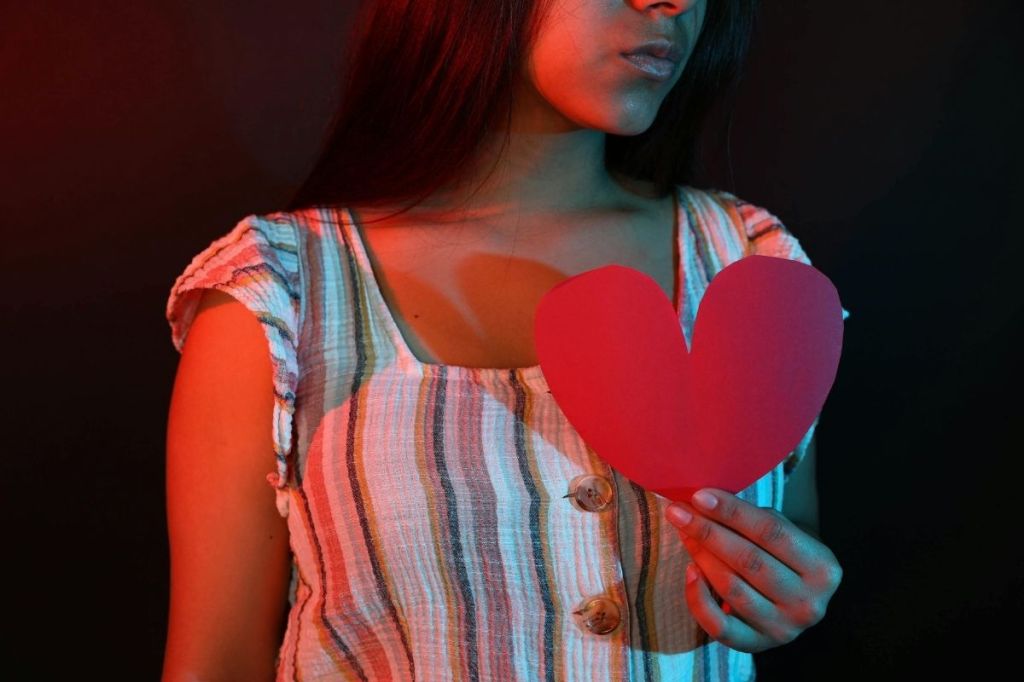
After Hannah had put up the card, Lily picked up a paper heart, which appeared to have been cut out from a piece of graph paper. Someone had scribbled on the heart on one side, then decorated the edges with a magenta glitter pen.
Hannah wrinkled her nose. “Ew. Who gave you that one?”
Lily shrugged, lowering her head. She reached for the tape, but Hannah snatched it and held it away from her.
“Don’t put that one up. It’s ugly.”
“But, maybe it should get a place,” Lily said. “Plus, it’s my room, too.”
I smiled and continued to watch them paste the hearts to the wall. All the while, Tommy stood beside me without saying anything. I traced his profile with my gaze, noticing how it was sharper than those of his sisters, the edges of his nose and mouth harder.
Later that afternoon, as I stood at the front door, ready to leave, Tommy pressed something small and thin into my hand.
“What’s this?” I asked. I opened my palm to find a heart-shaped piece of paper with a colored pencil drawing of two stick figures riding bikes. One of them had wily blonde hair like Tommy’s. The other wore a blue shirt, not unlike my favorite royal blue tank top, and had brown hair flying out behind her.
“For you,” Tommy said. “I had to improvise.”
As I started to thank him, his eyes widened, fixated on something, or someone, just behind me. I turned around and found Shane in a salmon button-down and khakis, head cocked to the side, standing at the edge of Tommy’s driveway.
“Figured I’d find you here,” he said. “You’re always here. Are you allergic to me or something?”
“I thought you didn’t do Valentine’s Day,” I said. In all the time we’d dated, we hadn’t celebrated it together.
“What’s that?” Shane pointed to my hand, which had closed in a loose fist around the paper heart.
“Oh, it’s nothing.”
“Let me see it.” He approached, then grabbed my arm, hard.
“It’s nothing,” I said through gritted teeth.
“Dude, leave her alone,” Tommy said.
Shane yanked on my arm, and I fell forward. I opened my hand to help catch myself, and the paper heart slipped loose. Shane bent down and picked it up.
“This is nothing?” He shook the heart at Tommy. “What kind of fifth grade trash is this?” Tommy stepped between us. Shane towered over him by at least six, seven inches by then. Tommy swung, then Shane crumpled. A grunt squeaked out of his throat, a windy, throaty sound. The paper heart, now wrinkled and torn at the edges, fluttered back to the ground. I snatched it, then ran all the way home. I had never known Tommy to punch people, though he told me he would if anyone ever tried to cross the two of us the wrong way. The two of us, he said, and I spent a little too long thinking about the way he’d phrased it.
That night, I examined my arm in the bathroom mirror. Three thick, red marks rose from the skin. I touched them with my index finger, then winced. The next day, they’d turn purplish-green, like a rotting plum. Shane called me again and again, but I didn’t answer. In the hallways at school, I avoided his gaze. At lunch, while I usually ate at the swing dance club table with Tommy, I sometimes ate in the library. On the days when my throat constricted, when a current ran across where the bruises used to be, I retreated to a bench between the stacks and ate. Most of those days, Tommy found me.
For years, I tamped down any accidental closeness: a brushing of hands, an unexpected invitation to a family dinner, a longer-than-usual hug. No one threw plates or yelled at Tommy’s house. No one made fun of my bike or my barista job. Tommy made me a paper heart because he didn’t want me to walk away empty-handed. I didn’t want to risk that, but I didn’t want to pull away.
***
After I’d finally gotten to use the restroom, I ran out to my car and started it up. I could stay here, away from Tommy’s sympathetic smile, Shane’s familiar grip, but if I didn’t do this now, I wasn’t sure I ever would. When I pressed the eject button on the CD player, it paused momentarily before spitting out the disc. Then I slipped it into its case with a click, locked the car and ran back into the club. Someone near the front of the line shouted, but the bouncer let me through anyway.
I pushed back through the crowds until I’d reached Tommy. He’d rolled up his sleeves, and his forearms and neck shone with sweat. A few feet away, Melanie and the other girls posed for a selfie. Teresa made a duck face, and Jessica stared, unsmiling, into the camera. Then someone bumped into Melanie, and she fell backward, feet and arms flailing before she hit the ground. Ice cubes scattered across the floor like dice. Tommy stood up, but she waved him away, laughing.
“I wanted to give you this.” Our fingers grazed as I handed Tommy the case. He stared at the CD, then up at me.
“Thanks. But how am I supposed to carry it out?”
I bit my lip. Teresa helped Melanie up, then began to pick up some of the ice cubes and put them back in Melanie’s cup. Didn’t Tommy want his CD back?
“You could put it in a bag or something. I don’t know.”
Tommy laughed. “I forgot how funny you are. How’s the dating scene at Unity? You find any nice guys at swing dance club?”
I realized then that Tommy knew nothing about my life at college. He didn’t know my roommate’s name or that I had decided to double major in Math and Education. He didn’t know about the drunk guys who banged on my dorm room door after a frat party, looking for Eliza. He didn’t know that I almost failed Intro to Anthropology because I kept getting off work late, and the professor took points off your grade for that. The people who knew me best at college knew almost nothing about Tommy. Only that we’d been friends as children.
“Not yet. But we’ll see.”
The lights above us turned red, and I recognized the steady thump-clap intro of Taio Cruz’s “Dynamite”. I started to dance again, easy enough for a song that repeated the word “dance” so many times, like an incantation. I spun around, then waved Tommy over to join me. A couple of his friends inched toward me, drinks in hand, mouthing the words to the song. When the chorus started, Tommy finally stood up, CD still in one hand. I realized then that I didn’t want to dance with him anymore. That if I hadn’t asked him to join me, he would’ve stayed right where he was. I waved goodbye to the others and headed for the exit one last time.
***
I woke up at seven the next morning. Even as exhaustion kept me weighted to my bed, my eyes refused to stay closed. Even on the days I most wanted to sleep in, my body stuttered awake at six or seven am. Morning shifts ingrained themselves into my body and brain, and I no longer tried to fight them.
Junior year of high school, I had Saturday morning shifts at Hazel Town, a coffee shop in the new mall the city built near my school. Every Saturday, my father would make me coffee and fried eggs. He had the early shift at his job, and he often drove me to Hazel Town. The blue-grey dawn slipped over the highway like a blanket, and we zipped along in the sparse traffic, a radio talk show crackling from the speakers of his old Buick. The whirring of blenders and my father’s car motor became the music of my Saturdays. Noises that, for their familiarity, soothed me more than the quiet.
My father used to move through rooms like he was windswept, limbs splaying until they grew firm and tree-like in his exhaustion. The day he left, I watched him throw a set of plates, one by one, into our living room wall. When I ran outside, I found my ten-speed Schwinn, bright red with a banana seat, lay dented and crumpled on the driveway, like bones gnawed by an animal. It was the only time I’d ever seen him break anything on purpose.
The day he left, he took only a suitcase and a chain of paper cranes I’d made in school. Mom tried to glue the plates back together, but the glue didn’t stick, and she cut herself over and over before she gave up. She moved through the house in the same way Dad used to, greasy hair tucked behind her ears, the bruises on her neck no longer covered by concealer, eyes glued to the floor or whatever object demanded her attention. I used to wonder if the battered look was a symptom of love, of loving hard, until I learned differently. I wanted to ask her if loving my dad was more like climbing a mountain or entering a dark cave. If it was anything like standing under a spotlight, fingers hooked in each other’s sweaters.
A text message from Tommy popped up on my phone, but I dismissed the notification. I made myself breakfast, then dug through the garage until I found Mom’s old bike. The silver paint had eroded in uneven stripes, but otherwise, it looked unchanged from years ago. I inflated the tires, then rode west through the neighborhood, past the red brick townhouses a street over from Tommy’s, where I imagined my father might have lived if he had been a different person.
In one window, I caught sight of a small, brown-haired girl, about Tommy’s sisters’ age, watching TV. I recognized the show: six sequined fairies, small and lithe, facing a trio of witches. Those winged girls thin as paper. Their doe eyes cherubic and eternally surprised. A fairy in a turquoise skirt and halter top held both hands to her cheeks, a flurry of hearts cascading around her. I felt like she could see right through me, see me looking into a house where I didn’t belong.
I kept going. I thought of Hannah and Lily, tacking up their proof of love. Someone had made them valentines, had cared enough to cut along the lines. I thought of Tommy, pressing a paper heart into my hand. When I got back to San Antonio, I would ask if I could switch shifts at Perfect Blend. I would go to swing dance club, maybe Latin dance club. I would ask Eliza if she wanted to come with me. I’d make a paper heart, no initials, and tack it up in my room. I would decide when and how to fill it in.
Courtney Justus is a Texan-Argentinian writer living in Chicago. Her adolescence spent in Buenos Aires and her Argentinian heritage frequently inform her work across genres. She is a 2022 Tin House YA Workshop alumna and a Best of the Net nominee. She earned her MFA in Creative Writing from the University of North Carolina Wilmington. Her work appears or is forthcoming in Barrelhouse, Jet Fuel Review, Anti-Heroin Chic, Hobart and elsewhere. You can visit her at courtneyjustuswriter.wordpress.com.
 ELEVENTH HOUR LITERARY