
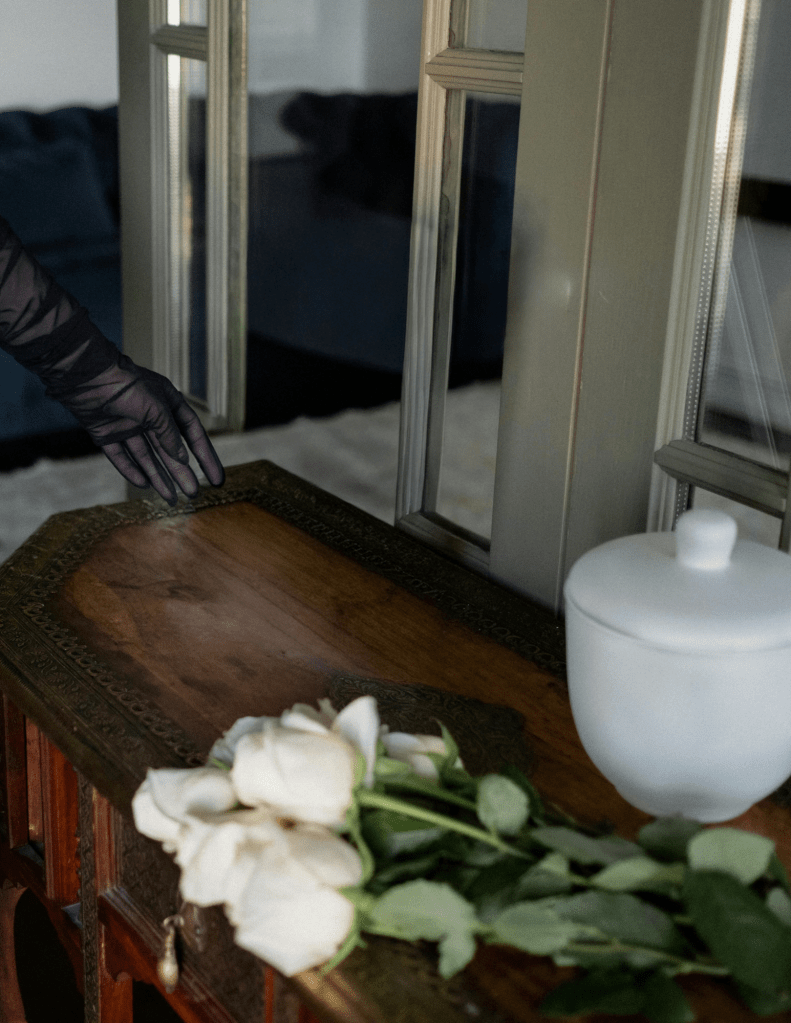
It is the Saturday before Valentine’s Day and I’m driving west down Woodstock Boulevard, on my way to a vintage shop with well-curated booths — I know precisely the item I’m looking for. Last week, I stopped to look for a lidded vessel to hold a small amount of my dog Elle’s ashes and found an antique Burmese trinket box, black and gold and lacquered to shine. I held it in my hands, but I wasn’t ready to own the box that would hold her remains, not yet, so I set it back on the shelf and walked out of the store. Not even two weeks ago, I held her while I whispered in her ear what I imagined the threshold between this plane and the next to look like. I walked beside her there until I could go no further, and she had to venture alone. The vet pressed a needle into her haunch then and plunged, filling her body with the solution that stopped her heart. When her last breath left her lungs, I took it into my own and promised to carry her with me.
I’m stopped at a light and to my left, a young man waits on the front porch of a house, two-storied with chipped siding and a deck to protect visitors from the rain. He holds the screen door open with his foot. In his hands, a dozen roses and a giant teddy bear, half the size of him almost. He looks nervous. There is a lot of bouncing.
Who is he waiting for? Are they expecting his face when they open the door? Are they expecting roses, and teddy bears, and his bouncing, nervous love? The light turns green and I hesitate. I want to see who will be the recipient of his gifts, but the car behind me honks, two short, friendly beeps, so polite, and I creep through the signal to go. I check my side view mirror, but when I lose sight of him, he’s still waiting.
I plan to spread Elle’s ashes in a few of her favorite places, and today I have been driving between antique shops, looking for the right containers to carry her. In a few weeks, I will bring some of her ashes with me to Alaska, where she, an Alaskan husky, was born and raised for the first nine years of her life. Elle was a sled dog, born to her mother, K2, and sire, Magma, at Chena Hot Springs, at a time when my dear friend Laura managed the resort’s dog yard. Half her litter died of parvo, but Elle survived. She was so shy as a puppy that Laura carried her in her shirt sleeve and asked every tourist who was willing to cradle her small, reluctant body and whisper sweet things to her and draw their fingers on the soft fur between her eyes and she grew to like people, and eventually, to trust them. Laura gave me Elle when I visited Alaska to celebrate her 40th birthday and my life was a mess, newly divorced and in a new state, in an unfamiliar city, in the middle of a botched attempt to begin again. A dog will help, she said, and of course, she was right. Three years Elle and I were together, the same number of years I wore a ring on my left hand, and in that time she wove the silk of her through the wounds of me.
The diagnosis came on a Thursday. Close to a dozen tumors in her abdomen, presumed metastatic. The results of her imaging were familiar. They looked like my mom’s glowing PET scans at the time of her diagnosis. I listened to the vet list the cancer’s locations and I was no longer in my car outside of the vet clinic, waiting for word she was ready to be picked up. I was in my mother’s kitchen; she was holding my hand. The vet’s voice adopted the tender tenor of my mother’s, their vocabulary the same: diffuse thickening, lesions, bright spots, metastasis, terminal. Four days later, I helped my little sister die.
My grandfather was a flower farmer, the best of his time. When he was in business, he owned the largest greenhouse under glass in the world. His roses were divine. They were what he was known for. This holiday, Valentine’s Day, this was his holiday. People like him manufactured this celebration, and still, it persists, roses the flower of the day. They are not grown under glass in Wisconsin anymore, but in places like Ecuador and Colombia, where rainforests have been clear cut, the soil inundated with poison to satisfy the western world’s insistence on arbitrary symbols. My mother died of cancer. Just last month, a friend asked me if I thought her disease was related to pesticide exposure, having grown up on flower farms and in greenhouses. I had never wondered about that, and this surprised me, and I thought then of the farmers in South America, of their children, holding the hands of a dying parent, a vase of roses beside their deathbeds, maybe. Perhaps the boy on the porch wishes for his adoration to metastasize in the body of his lover, to begin in the heart and spread like fire, to overtake their organs, to become at once dependent and merged. Does he understand that this symbol of love he delivers is, too, an emblem of death? Grief is love’s other face.
I keep my left hand on the wheel and rest my right on a pile of containers in the passenger seat and picture the lacquered box on the shelf where I left it, black like onyx with a many-petaled lotus etched in gold on its lid, small enough to fit in my palm, to close my fist around its curves.
At the last antique shop, I bought a small, carved wooden box and two pine needle baskets with lids. I don’t need both baskets, but I had such trouble making a choice. I picked up the smaller of the two and set it down, then picked up the larger and set it down, then picked up both at once and held them side by side. What size would I need? I tried to visualize the size of the paper box that holds her ashes now, that sits on an altar between vases of flowers that have dropped their petals and tapers burnt nearly to their ends, beside her leather collar. I worried the smaller one wouldn’t hold her. I worried the larger one would drown her in all that extra space. The difference in size between the two is perhaps an inch and a half. I carried the larger basket around the store with me and before checking out, wandered back to the booth, collected the smaller basket, and bought them both. You choose, I said aloud, and I could say I said it to no one, but I didn’t. I said it to Elle.
My plan is this: I will fill the carved wooden box with a small amount of her ashes and bring it with me to Alaska. Laura and I will spread them in the woods on her property, beside the dog yard that was once Elle’s home. I will return to the vintage shop on Woodstock Boulevard with well-curated booths and the antique Burmese trinket box will be right where I left it and I will buy it, and fill it with some of her ashes, and these will stay with me. The rest, I will keep in a bag inside the pine needle basket — her choice — until spring, when the Oregon iris is blooming, and I will bring her to our favorite place above the sea and scatter most of her in the iris patch, but give some of her back to the ocean.
The trinket box is right where I left it. It is precisely the size of my palm, and I place it there, wrap both hands around the rounded vessel, and hold my hands, like a prayer, to my lips.
I am driving east now, down Woodstock Boulevard, past a house where, inside, a young man offers his love a gift of roses and bears. On the seat beside me are three things: a carved wooden box, a nested set of pine needle baskets, and the antique Burmese trinket box. Our offerings are not so different, me and the young man. His roses say I love you. They say, one day you will die and I will hold your hand and take your last breath into my own body. They say, I am here, and I will always be here, and it is exciting to love you and also I am afraid, because there is only one way out, there has only ever been one way out, and it will come too soon and it will end in ash and pine needle baskets and lacquered trinket boxes and your pulverized bones laid in the places you loved best. They say, little sister, I will carry you home. I will carry you in my lungs.
Elizabeth Grey is the author of the memoir Migration, forthcoming on Milkweed Editions. Her essays have been previously published or are forthcoming in Off Assignment, The Forge, Buckman Journal and elsewhere.
 ELEVENTH HOUR LITERARY