
February
Ben meets Ril. It is extended happy hour night at the brewery, a weeknight that sees the place more packed than any weekend all year. The place is loud with chatter and laughter, pool and darts.
“My name’s Ril,” she says.
“Real?” Ben asks.
“No, Ril. R-i-l,” she says.
Never heard that one before, he thinks.
“What do you do?” he asks.
“I’m a fisheries observer. You?”
“Oh cool, I’m an aquarist.”
Fish are a reliable opener in this town, but what seals the deal is when the conversation shifts to books. The two can barely sip their discounted beers between words once this begins. Ril reads a lot when she is “stranded at sea” on the commercial boats when they aren’t actively bringing in fish, as she wasn’t an especially welcomed member of their crews. Ben reads a lot during his off hours in the winter, as it’s easier to indulge his recluse when the weather gets crummier. The two have similar tastes, but also throw out titles and authors one or the other has never read before. They find pens and get napkins out. Ben writes down: David James Duncan, Ken Kesey, Tom Robbins, Richard Brautigan, Haruki Murakami, etc. Ril writes: Louise Erdrich, Ursula K. Le Guin, Rick Bass, Karen Russell, Mary Oliver, Ross Gay, and so on.
They hardly notice when people began filing out for the night, the sounds from the pool table and elsewhere diminishing. When they finally do, Ril takes a long sip of her remaining beer with one hand and writes her number at the bottom of her long list with the other. When her beer’s gone, she looks at Ben with earnest eyes and asks him to call her when he finishes each title. She explains that she doesn’t often get cell reception at sea, so he might have to leave her long-winded voicemails to convey his thoughts. He enthusiastically agrees and writes his number down the edge of his own recommendation napkin.
Ben calls and talks to himself on the phone, happy enough to hear Ril’s voice recording before the beep. When Ril’s on land they get together for literary discussions over happy hour, at the coffee shop next door, or on walks on the beach or to the lighthouse on the point if the weather isn’t too gross out. They come to like walking best. Sometimes their steps are in sync strides. Other times they veer towards another without realizing, and Ben corrects his steps self-consciously, but coolly—he hopes. He tries not to be too hopeful.
Ben is beyond grateful to have someone like Ril to talk to. He can’t believe it took him so long to meet her and he feels more engaged in his life than before. In comparison to Ril, his co-workers at the aquarium and barroom friends start to feel more like acquaintances at best, flies on the wall at worse. Young people come and go in this town so frequently he’s never gotten too invested. But now Ben daydreams about a fuller future in this place than he’s ever allowed himself, and each day gets lighter. However horrendous the rain and wind still could be, promise is in the air.
March
April tells Ben that is her full name.
“I’d wondered,” he replies.
She explains: Ril was her old softball nickname back when she played at her community college before transferring to a marine biology program in NorCal. She’s originally from the Midwest, as is Ben.
“I brought Ril back into use when I applied for this job,” she tells him. She was worried about sounding too obviously feminine. Even in this age she’d been around one too many who didn’t think a woman should be working at sea.
She tells Ben: spring is her time; she is spring’s child. She asks if Ben would want to go searching for wildflowers later on in the season, and of course he says yes. They have never spent more than a couple hours together, and the thought of a long drive to the remnant prairies in the valley with her by his side is not something he’d ever dream of passing up.
“April, a most pregnant month indeed,” he clumsily quotes after they make loose plans.
“Brian Doyle,” she smiles. “What was it—rambling and shambling—”
“The Grail: A Year Ambling & Shambling Through an Oregon Vineyard in Pursuit of the Best Pinot Noir in the Whole Wild World,” he corrects in nervous excitement.
It is a book he had recommended her, one in a slew of Oregon-themed ones he had read in a row not long after he got his first permanent job here. April hasn’t yet reviewed it.
“Hey—while we’re out there, might as well pop by a winery on our way back right?” She asks, she offers.
“Sure,” he says, “I’d love that.”
At the end of the month, Ben is ecstatic to flip his calendar to April.
April
April is at sea a lot. Ben daydreams about her while work plods along as it usually does at the tail-end of winter, in preparation for more visitors just around the bend. It always has puzzled him why more people don’t visit the aquarium in the winter when it is so much harder to see marine wildlife outside with the weather so much more hit or miss.
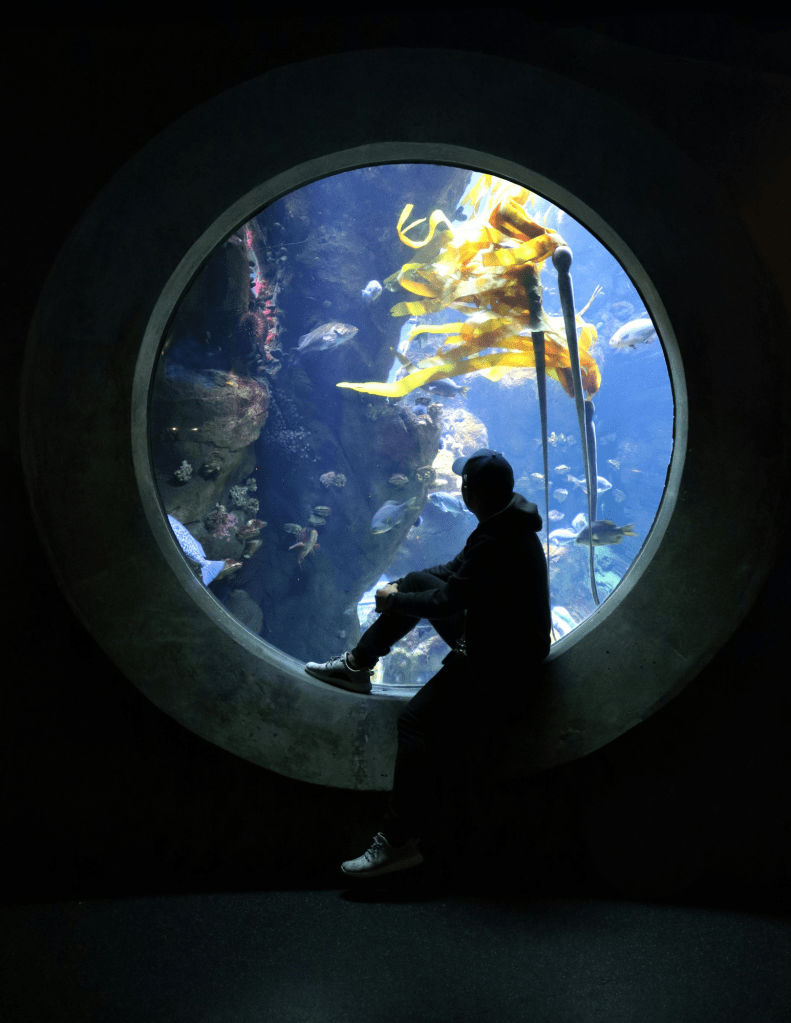
Each morning, he prepares the exhibits for opening to the public. Ben works with fish (rockfish, lingcod, wolf eels) and invertebrates (anemones, octopus, jellyfish). All of the birds (murres, puffins, pelicans) and especially the mammals (seals, sea lions, otters) are left to the jocks of the aquarium staff. Ben is a book guy. He works with the fish. And invertebrates.
He prepares their food; each animal requires a strict diet rich in the nutrients and vitamins particular to their species and natural habitat. He cleans and improves their exhibits. Just before or after Ben takes lunch he maintains the filtering systems and performs water quality checks. In the afternoon he feeds some of the animals again, takes on new or special projects for the exhibits, and makes sure all is smooth and safe for overnighting. Mostly, each day has its routine. Surprisingly, or not so surprisingly, taking care of living organisms just feels like a whole lot of busy work most days.
The staff doesn’t get to get out of the aquarium much. Ben occasionally gets to join on diving trips to offshore reefs when the seas calm in the summer months. Those are his favorite days, when he gets to put his scuba cert to use and be on the lookout for new critters to add to the mix, or help transition healthy animals back into the wild.
Honestly, he never thought he’d last this long in an aquarium setting, dependent on tourists. This isn’t SeaWorld, with giant whales in undersized tanks. But there are still wild animals that would otherwise be contributing to their natural ecosystem. Kept in captivity to educate and inspire. The job’s consistent enough, the pay is reasonable, the co-workers are likeable, and the coast is so dramatically beautiful it seeps into the skin. When it rains too hard there are books, and with books now comes April. Ben stays on.
May
One day, April calls while Ben is armpit deep in a fish tank. He finishes the task at hand, dries his arms, then listens to the voicemail.
“I know it’s a workday for you,” she began, “but the ship came back early and it was a nasty trip. I’m getting cleaned up and then headed to the valley for some land medicine. Hope you can play hooky with me?”
He mentally reviews the projects he had planned for the afternoon. Nothing so essential he can’t leave it for the intern that will be in soon. Ben is quick to explain he feels like he’s starting to get a head cold, maybe allergies coming on. Before he heads out, he texts April to tell her he’s in. His hands are shaking so much he has to type the short message three times to fix his misspellings. She sends him her address and says she’s ready when he is.
Ben stops by his apartment to change first, putting on a nicer flannel and dark wash jeans. Casual clothing still, but items he’d never dare wear around the saltwater tanks. He doesn’t want to take too long, but he can’t help himself. He puts together a picnic basket with goat cheese from a farm on the nearby river, water crackers, hazelnuts, a couple white nectarines that he couldn’t resist at the co-op.
Ben drives to pick April up, and it dawns on him he’s never seen where she lives before. As he pulls up to the curb, it surprises him how nice it is, given that she spends most her time at sea. It’s one of the few original craftsmen style houses in town that hasn’t been left to rot, up on the hill above the commercial docks. The cedar shingles have been painted over in green, and the paned windows, roofline, and wooden front door are a deep purple. The path to the front porch is hedged in by rosemary and lavender, daffodils and tulips in bloom. An orange cat with a little bell on its collar sits on the porch railing, purring as Ben makes his way up the steps and reaches out to pet it. The cat leans into the offering. He can hardly extract himself, but he does, and he knocks on the door.
April calls from inside to come in. She’s still throwing things into a canvas bag on the kitchen butcherblock island, wearing a linen romper, wool cardigan, and nice boots. Definitely not saltwater wear either, Ben thinks happily. She excuses herself to use the bathroom before the long drive, and Ben admires her aloe vera, jade, and cactus plants spread out on nearly every windowsill wide enough to hold them. Peace lilies, spider plants, and prayer plants sit on the coffee table and fireplace mantel. The fireplace looks to be wood burning, the real deal.
He can hardly believe someone his age lives somewhere so nice. Just when he’s about to turn to complete mush on the worn oriental rug beneath his feet, April returns, and leads him out the front door.
On the drive, they listen to the local radio show’s podcast hour. They barely talk and this too impresses Ben. He hates it when people feel compelled to fill silence with meaningless babble. Occasionally, one or the other points out an interesting bird they see; most notably, turkey vultures are back for the season, teetering gracefully as they soar through the sky.
The show ends about ten minutes out from Finley National Wildlife Refuge. A gravel road loops through the refuge with sightseeing pull-outs all along the way, which Ben and April happily use. Much work has been done here to restore native prairies, oak savannas, and floodplain wetlands, making the blooms jaw-dropping. Golden paintbrush, camas, Oregon irises, checker mallow, and a variety of native grasses make the whole scene something straight out of a plein air painting. The air is warm and humid and gray clouds blanket the sky, making the yellows, purples, pinks, and spring greens pop even more.
“I think this is the best I’ve ever seen them,” Ben says of the blooms.
April brought a film camera and half-heartedly apologizes for the motherload of pictures she takes, close-ups and landscapes and dozens of angles of the same flower. Ben doesn’t mind one bit and likes trying to guess at what she is seeing through her lens. Above the fields, swallows dart in and out of homemade bird boxes, a blur of violet-green. At the top of the slope above the road, old-growth Oregon white oaks are still in the process of leafing out, a brighter, more dazzling green than they’d be all year, and their branches are a tangled twirling mess against the gray sky above.
Ben and April amble down the looped road, in and out of the car, with the two staying rather quiet, but happily so. At least, mostly so, as Ben is starting to get hungry. He snuck out of work so quick he didn’t eat lunch but doesn’t want to seem rude and start digging into the food he brought until they reach the right spot. When Ben’s stomach grumbles incredibly loud, April cracks up.
“Want to stop at one of those wineries? I packed a picnic.”
Ben beams.
“Same here,” he replies, and they are off.
The winery is on the way back to the coast. The clouds are starting to break in the late afternoon, revealing golden light behind them. They sign up for a flight of pinot noirs to share, and they take them outside. Adirondack chairs are arranged between the rustic room and the grapevines, where a stream runs near enough that there is no need for music.
Ben and April swirl their glasses when they arrive, sniff, slowly sip, and snack on the bounty they each brought in between. To Ben’s goat cheese, there is April’s Dubliner cheddar. To his water crackers, there are her buttery rounds. His hazelnuts, her almonds. His nectarines, her green grapes. Yes, they are wine tasting. But they are tasting so much more.
When they make it to the last pinot noir in the series, April suggests they take their glasses down to the stream, where the road crosses it through a covered bridge. Swallows dart in and out of the rafters as if it were built for them. They pay no tangible mind to the human visitors joining below.
“They’re co-housing,” April says, looking at the nests. “I thought I would bring housemates on when I first bought my place, with how hard it is to find rentals here. But with me being gone so much… I don’t know. I wanted it to still feel like mine when I came home, you know?” She laughs, maybe nervously “Is that selfish?”
“I used to want more of an at-home community too. I guess in a small town, you see the same people at work as you do whenever you go out, and do you really want to see them at home too? It’s nice to have a little separation.”
They turn their gaze from the bridge ceiling to lean over the railing at the stream below, the water bubbling along with their conversation. They reflect on how their initial perceptions of living on the coast have changed the longer they’d been there. For Ben, it’s been two years. For April, nine months.
“Honestly, I’m not sure I ever thought I’d last this long on the commercial boats,” April says. “Even if no one’s being really overt, most have made it pretty clear they don’t care for my work. I think I’m finally getting that it’s nothing personal, you know? But it’s still hard some days; it still feels personal. And then the nice ones—fuck, the nice ones can be so belittling it drives me bonkers too. Like, they like me, but they still don’t see me as equal. But then the pay is so good, and I get to read on the job! It’s such drudgery and dreaminess all at once.”
Ben thinks of taking care of the animals at the aquarium. Their tanks, the pipes, the water itself always threatening to do something out of line. It wasn’t the same as working with fishermen for sure, but he nods knowingly anyways, looking at her now instead of the scenery.
“Yes, that’s exactly it. The drudgework of dreams.”
“I’m glad to have met you,” she says, holding his eye contact.
“Same here,” He musters, and leans in.
They kiss under the rafters of that covered bridge, under the swirling swallows’ flight above, the gurgling water below, with the last of their pinot noir—the poet’s wine—still settling in their glasses.
June
The daylight is long. April is at sea a lot. When she is on land, Ben stays at her house. It doesn’t take long for her to give him the spare key, telling him it’s fine by her if he lingers after she leaves. Millie—the cat—would like that. Ben likes Millie. Ben keeps her out of the cacti prickles when she gets too close. The two watch the action on the bird feeder hanging in a Monterrey cypress out the window. It’s always busy with chickadees, dark eyed juncos, goldfinches, and grosbeaks once they migrate in. April never forgets to fill it with seed before she leaves, knowing that they enjoy it so much, and she enjoys listening to Ben’s voicemails describing the action out the window. Though Ben misses April when she is gone, the cat, the houseplants, the little birds, her books, her soaps, the creaking wooden floors and cabinets in that charming old house—all these things make her feel present somehow. Plus, he buys a calendar for the house and sometimes they leave each other little notes in the boxes of each day as they come and go. He loves her slanted handwriting, the words she chooses.
The first couple times Ben and April arrive at the brewery together, their friends give them those sly little looks of recognition. Somehow this makes Ben feel like these people are his community, even more than before. They go to their houses for potlucks, or to beach bonfires with them. When April is gone, Ben takes the time to check in with them, to stop by and see their gardens growing, to have a beer on their deck with them when they offer.
April says she’s getting along better with the fishermen too. They seem less doubtful of her abilities, less skeptical of her purpose on their boats. She reminds them that she is there to sample their bycatch not to get them in trouble, but to gather data that contributes to a better sense of the state of the various fisheries and threatened stocks. She even begins sincerely joking around with them, she says. Not just jokes to make her day easier, but actually connecting with them through humor. It’s a happy surprise for her, and Ben is happy for her. Together, they are making this place work.
July August September
The northerly winds stall and it’s like a second spring. Asters are still blooming all over the coastline, with mushrooms occasionally bursting out of the duff after heavier drizzles as if they too were blooms.
April has now been on boats out for crab, shrimp, halibut, hake, rockfish, salmon—the fisheries themselves were getting easier as the seasons carried on, she explains to Ben. The crews are more relaxed. This time of year was hot for tuna, which meant farther trips offshore to where undersea canyons dove down off the continental shelf and the fish schooled up. It meant even more time away from land, away from Ben. She comes back each time with a face more freckled from so much time under the sun, and leaves with eyes eager for the open ocean. Ben is jealous. She’s chasing fish while he houses them. And invertebrates.
The fall equinox flies by out of nowhere, and the sunsets get earlier. Ben watches them alone on the beach or on April’s front porch while Millie purrs on his lap. He’s moved most of his things in but his apartment lease remains intact. He feels lonely at both; he finds himself longing. Everyone in town seems busy. Fair weather projects can’t wait. Gutter repairs. Siding painting. Trimming shore pine and spruce limbs before the winds kick in again and threaten to take them down by their own means. Every now and then, Ben offers his help just for something to do. He tries to exhaust himself out of his loneliness. Tourist season is coming to a close, which means less visitors at the aquarium and more intricate maintenance tasks to do that had been put off. When he’s too tired to interact with anyone he keeps checking off April’s reading recommendations, saying words after the phone beeps.
One day, April comes home pissed. One of the bigger boats had a new deckhand that was completely out of line with her, getting in the way of her sampling even as it put him behind on his own work, and none of the guys she thought had come to respect her did anything to stop him. She tells him that the whole trip, she kept having the feeling they were all laughing at her behind her back, or looking at her when she was turned in a way that gave her serious creeps. Their bodies too close.
Ben’s thinking: I don’t like this. Not at all. Ben’s thinking: I don’t want this to go too far.
“Do you have to go back on that boat? Could you file some sort of complaint?” Ben asks.
“Nothing that would change anything,” April sighs exasperated. “Like, fuck, I’ll get on that boat. Just signed another six months contract.”
She covers her face in her palms and stomps on the wood deck below her. Millie jumps away. Ben holds her shoulder. She leans into his.
“God, I thought this part of the deal was over.”
What could Ben do? He knows he’ll miss her again soon. He resents her job for that. He resents that her job is now making her miserable when she is home, instead of further enabling her to take in this place and its people in stride with him. Ben doesn’t dare ask if she’d contemplate quitting. He’s never felt comfortable in a place even close to suggesting someone what they should do. Finally, April breaks the quiet.
“It will get stormier again soon, and my trips at sea will get shortened. I just have to tough it out for a while, that’s all.”
Ben squeezes her shoulder.
“Hey, how long are you on land for this time? I heard the winery put in a new woodstove inside, maybe we go and see how the fall colors are shaping up soon?”
“Yeah, that would be nice Ben. You want to go tomorrow?”
“If you’re up for a little drive, I’d love to.”
“Okay, let’s do it. That will be nice.”
She rests her head on his shoulder again.
October
April doesn’t tell Ben when she decides to put her house on the market.
“I wanted to tell you before the signs went up, before it was listed online,” April says.
Ben looks at April seated on the couch. He looks out at the bird feeder. Currently empty. No action. He looks at April. Stale.
“You don’t have to take your things or anything. We can keep staying here until it sells,” April says.
“What’s after that?” Ben asks.
“Once it sells I’m giving my two weeks,” she answers.
“And…what happens after your two weeks is up?”
“I’ll be done. Won’t have to deal with shit people anymore. I don’t know. But I can’t afford the mortgage on this place without that job, and it’s a seller’s market right now.”
“Where will you go April?”
“I don’t…”
Ben realizes he’s always wanted to know where April will go. Most of their time together, they’ve been apart.
“I mean, I’ll go home for the holidays. Thanksgiving is coming up. I haven’t been there in two years, and haven’t seen my family in one. It’ll be good to have sort of an extended stay with them.”
April filled Ben’s silence. He hates it. The way her speaking words into space pushed all alternative futures to the side.
“So, you’re moving home,” he decides. Before she can fill in the holes for him again.
“Just for a while. Just until I can get some bearings again.”
He doesn’t want them to be done. He doesn’t want to leave. He wonders if he can stay here now, knowing she’ll soon be gone for a much longer period of time than she ever had before. Can he stay with her not knowing what her plans would be down the road, if she’ll ever come back? He doesn’t like how drawn out the not knowing might be, the constant threat of the next big quake. But imagining going back to his old life in this town without her is an instant impact, a landslide that’d take out the home he thought he’d built.
“Okay,” he says. He later regrets. But what else could he do?
Their last days together would feel like playing pretend, and then they’d be done, she’d be gone.
November December January
The holidays come and go. Ben spends Thanksgiving with friends who feel real now. Not like flies on the wall. Not like just a part of his and April’s relationship. Like his. Some of them even begin talking books with him. They tell him their favorite George Martin, and Stephen King. Some of them surprise him. Ben stays around for Christmas and New Year’s. His family isn’t thrilled by his decision, but it will be easier to travel later anyways. Cheaper. He’ll come in February; he tells them. Somehow it’s nice to be in the aquarium alone during the meantime. They’re down to their skeleton crew. At the end of his shifts, sometimes Ben walks through the exhibits on the visitors’ side. It’s quiet. Away from the pipes and pumps and filters that keep this place running, he notices things. Things he’ll need to tend to later on, and far more wondrous things, like the unceasing expansion and contraction of a jellyfish. A smile parts his lips. It keeps him on his toes.
Of course, in the quiet sometimes Ben finds his thoughts drift to April. Neither one of them has reached out to the other since she left. Cold turkey. He wonders if their time together had been a false spring—that one week in winter that is so unseasonably mild it convinces the robins to sing and daffodils to blossom before the next week’s frost comes to bury them. Just a little natural tragedy, nothing that can’t be rallied from.
Just about when Ben opens his new calendar for the new year and recycles his old one, he’s informed that he’s getting a salary raise, on top of the holiday bonus he’d received a month ago. In this economic sense, he starts to feel more valued. He feels he has more stakes in the community. He visits his friends to see their winter craft projects, chops wood with them, sips beer while rain pelts the windows so hard it drowns out near all attempts at conversation. Ben continues to read. But for the first time, it is not so zealous. He is grounding himself in reality, he thinks.
February
Ben makes good on his promise to visit his family and makes the flight for a full week’s stay. It feels like its own holiday, with visits arranged by his parents to see extended family members, and large dinners planned with the neighbors he grew up with. Ben helps his mom in the kitchen, entertains nieces and nephews, ogles over the newborns, designs a new work bench for the garage and builds it with his dad. When he looks back on it later, he’ll wonder if they weren’t all getting along so well because of what, at the time, felt like conspirative rumors of an incoming pandemic. No one talks about it seriously while he’s there. When the news radio brings it up, someone or another flinches and turns the volume down.
Once back on the coast, the shortest month of the year takes to whizzing by, and the novel coronavirus becomes more and more real. Less and less visitors at the aquarium. Ghostly. Ben doesn’t worry too much about losing his job; he is indispensable to keeping the animals alive. But the director makes the call to whittle the skeleton crew down to just a backbone. Those left have more to do. Ben hardly sees his co-workers anymore; they are all so busy. He becomes jealous of his friends who are starting to work from home. They start these group messages he can barely keep caught up on, invite him to Zoom happy hours he arrives to late and exhausted. People talk about how grateful they are to live here, to have the beaches to escape to, to not have to face the reality that other cities in the state have to, and to be able to truly say they can’t even imagine what it’s like in New York City right now. Ben doesn’t know anyone directly who has tested positive or has had the symptoms necessitating the dreaded 14-day isolation. He doesn’t know anyone at risk of losing their job. He tries to rationalize out of his worst lines of thought, but sometimes he can’t help wondering what all this isolation is for.
March
Things get worse. Cases rise. Ben thinks about April. Wonders where in the world she is now. Hopes she’s safe. Part of him dreams she’s on her way back here, ready to face whatever is to come with him. Together.
Ben can hardly sleep. He learns the word for what he does after dinner is doom-scrolling. He vows to stop, to go to bed earlier. He begins to read voraciously again, anything and everything. He starts going on morning beach walks. Sometimes he starts from his apartment, rounds the bay on roads, and then hits the sand alongside open ocean. Sometimes, he drives and parks by the beach access stairs so he can walk on that expanse for longer.
Above the stairs, he sees homemade, campaign style signs pop up that in one plain way or another tell whoever sees them to go home. They don’t try to mimic the kinder framing of “Stay home, save lives” that Oregon’s governor will soon promote. Ben continues to park and walk several days a week, one day returning to a note underneath the windshield wiper: you’re not a local, go home. It hits him in the gut. Hard. He’s surprised. He stayed on when others left. When April left. People are always coming and going in this town. Why push him out?
Ben tells his family about the note and signs on a video call. They can’t help but critique the intense response the denizens of his 10,000-strong community are having, when they’re only seeing a fraction of the positive cases as they are. Ben feels defensive, and it surprises him. Carefully, they veer the conversation elsewhere.
In mid-March the world shuts down for real. Schools close. Bars and restaurants close. The aquarium closes. Ben is essential. He goes in to attend to the pipes and the animals. His boss initiates a new staggered shift schedule and if Ben thought the place was ghostly before, it’s a graveyard now.
Graveyard’s the wrong word. He keeps busy.
It’s all Ben can do to stop at the Post Office on his way home one day to deal with his overflowing mailbox, mostly junk he assumes. At home with a bottle of red nearby and pasta going, he starts through the stack. There are the usual bills he dreads, a catalog of community college courses he flips through—they must have scheduled to send it out early and unknowing. Then, a letter.
He knows the handwriting on the envelope from the slanted notes she used to leave him in their calendar when the days were just boxes, not boxed in. April didn’t write her return address though. Inside is a napkin, on which is a list of book titles, some familiar, some new. At the bottom of the napkin is her phone number; it hasn’t changed. There is a piece of paper scrawled over with more of her writing too. Ben reads.
Ben, I was thinking of the summer afternoons we spent up the river to get out of the fog and wind, to feel the sun and heat. We’d bring our books, food, and booze, lay out on those gravel bars and dip into the swimming holes we found unoccupied. Unoccupied by other humans that is, of course. I remember the time I brought my snorkel mask and you helped me put it on straight when it was catching my dry hair all wrong. You said farewell to me on shore and I dove in. There were juvenile salmon and trout I couldn’t identify before I scared them away, but the crawdads were happy enough to stick around with me in the quiet dark of those pool bottoms. It took a couple trips, but eventually I recalled on the surface how to empty my lungs just right so that I could sink to the bottom and be still enough that the fish would come back. By that point I didn’t care so much to get my ID’s right, I just wanted to be with them down there for as long as possible. I’m not sure I ever really managed to tell you how hard that job was for me at times. How less—or too much—of a human I felt, how much your company and our adventures meant to me, how much of a salve my time with you was. Maybe I’ve burned some bridges with you, maybe I shouldn’t be sending this. I won’t expect you to leave long-winded voicemails with all your evaluations of the things you are reading. But I don’t know, I’ve just reflected a lot lately and don’t want to go any longer without saying I loved you. The world’s just moving too fast not to. -April
Ben reads again. Then. Ben flips his calendar to April.
Ari Blatt is a co-founder, reader and editor for the publication Tethered Literary. Her own writing can be found in Cirque, SHARK REEF, Thimble and The Corvallis Advocate. Ari received a master’s degree in creative writing from Oregon State University–Cascades.
 ELEVENTH HOUR LITERARY